
In compliance with House Bill 4, a bill eliminating diversity, equity and inclusion (DEI) initiatives in Kentucky’s public universities, WKU has been tasked with flagging programs, scholarships and classes within the university that may not meet the bill’s requirements.
Vetoed by Gov. Andy Beshear, and then overridden by the Kentucky House and Senate via the Republican majority on March 27, HB 4 prohibits Kentucky colleges and universities from considering race, religion, sex and national origin when funding scholarships and making admission decisions. The bill also prohibits funding toward DEI-related programs and organizations, and DEI training and statements.
WKU, along with all other public universities in Kentucky, was required to submit an audit of the university’s HB 4 compliance efforts to the Kentucky Interim Joint Committee on Education.
“At its most basic, all universities are prohibited from providing preferential treatment or benefits, or promoting discriminatory concepts based on race, color, national origin, sex and religion,” Andrea Anderson, WKU general counsel, said during the Board of Regents retreat on Aug. 7. “We have evaluated almost every aspect of the university.”
As part of WKU’s compliance efforts, a committee composed of Anderson, Lindsey Carter from WKU’s General Counsel, and a representative from each academic college was tasked with reviewing course syllabi and materials that may not meet HB 4 requirements.
“The provost formed a committee to take a look at some courses that were identified as having potentially a discriminatory concepts,” Anderson said in the Board of Regents meeting.
Anderson said in an email to the Herald that the committee identified 50 courses offered in 2023-24 that may not comply with HB 4, including classes about the American Civil Rights Movement, Women’s Health and African American Literature.
Ryan Dearbone, assistant professor of broadcasting, is in his first year teaching Media Diversity, one of the classes flagged in the university’s audit.
Dearbone said that the class serves to educate students about how different groups of people have been portrayed in media.
“It’s (media diversity) not meant to make anybody feel shameful or bad about who they are, but more or less to educate people about how the media has shown things and how we see other groups based off of what the media tells us,” Dearbone said.
Dearbone said classes like Media Diversity make students think about new perspectives and more critically.
“There’s a responsibility in understanding your audience, understanding who’s out there, and understanding points of views and perspectives that may not be your own,” Dearbone said.
Dearbone said it is his understanding that classes flagged in the audit passed review, but that has not been confirmed.
On March 28, WKU released a statement online addressing the new legislation.
“As an institution that relies heavily on state and federal funding, we must ensure compliance with any new laws and regulations to protect the resources that sustain our mission,” the statement said. “Failure to do so could lead to significant reductions in our operating budget and limit our ability to provide essential financial aid, including Pell Grants. We have a responsibility to thoughtfully navigate new regulations while continuing to serve our students and community.”
WKU’s statement said the bill’s requirements would not diminish the university’s dedication to student success.
“WKU has always been – and will always be – dedicated to ensuring that every student – regardless of background – feels supported and has access to the resources they need to thrive,” the statement said.
Anderson said during the Board of Regents retreat that WKU President Timothy Caboni appointed a committee to review non-academic programs to ensure the university is providing resources to all at-risk students.
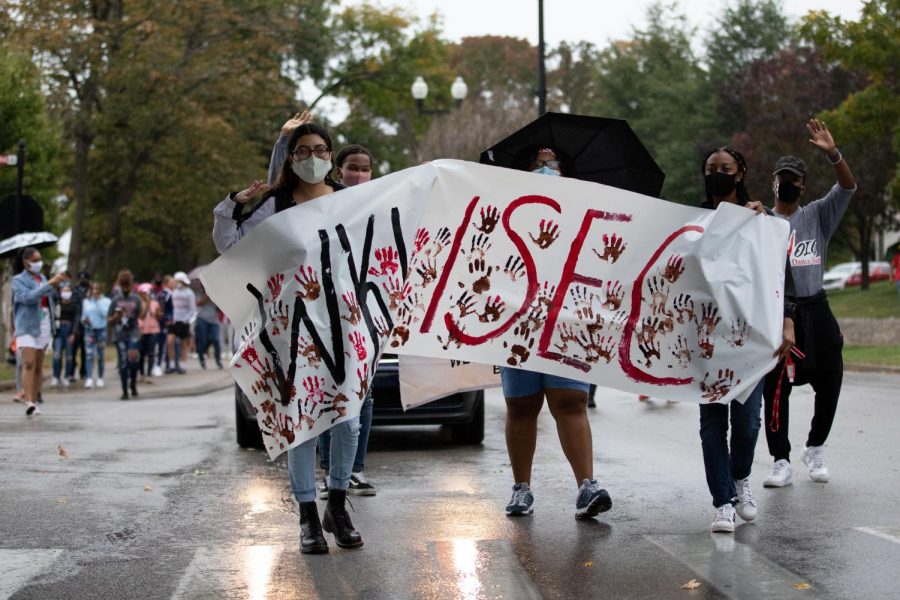
University programs like WKU’s Cynthia and George Nichols III Intercultural Student Engagement Center (ISEC), which provides students with support, community and educational resources, have also been flagged under the bill. The bill required the university to make necessary adjustments to ensure ISEC’s goals, resources and opportunities align with the new legislation.
University Spokesperson Jace Lux said ISEC’s funding and staff will now be listed underneath the Dean of Students.
“This transition allows the center to serve a wider range of students, without limiting support to identity-based criteria,” Lux said in an email to the Herald.
Conversations about whether to discontinue or reframe WKU programs are currently underway, Lux said.
Jar’Miyah Carneal, a junior psychology major, currently serves as a peer coordinator for ISEC. Now the vice president of WKU’s Black Student Alliance and the vice president of the Epsilon Zeta chapter of Alpha Kappa Alpha Sorority, Inc., Carneal said that ISEC laid the foundation for her time at WKU.
Carneal said that ISEC offers students skills and resources and connects them with WKU alumni and organizations.
Carneal said ISEC provides additional advising and networking opportunities and is open to any and all students. ISEC also offers additional orientation activities to incoming freshmen during WKU’s Master Plan week before each fall semester, like campus tours and financial aid support.
“It’s just that extra support that students need, especially as intercultural students,” Carneal said. “That representation we don’t get on campus, ISEC makes sure we get that, then we’re always seen and heard.”
The center’s webpage is currently under construction, and images showing students of color and resources connecting students to ISEC have been removed. The webpage’s tagline, which once read “Where education, students, and culture connect!” has been changed to “Where scholars are made!”
The program’s description previously included phrases such as “culturally inclusive campus environment,” “cultural awareness and competence,” “inter-group dialogue,” “engagement and intercultural interaction…” The program is currently described as a way to “support students who may encounter challenges in their pursuit of higher education.”
Other digital changes include alterations to WKU Pride’s webpage. Links to resources outside of WKU for “Trans POC (person of color)” students have been removed, as well as a picture of a graduation stole with rainbow colors.
Anderson said in the Board of Regents meeting on Aug. 8 that the university’s IT department had conducted an audit on university websites.
“We looked at our strategic communication plan and concepts and events that we are promoting through social media and other channels,” Anderson said.
The university has tasked the Center for Innovative Teaching and Learning to produce new training for faculty and staff to help them engage in the classroom while having difficult conversations.
The university was also required to change the way it responds to complaints of discrimination.
“We also amended the way that we respond to complaints of bias incidents or complaints of discrimination harassment, so that process has to be reviewed by my office before investigation,” Anderson said. “That’s a requirement of the new laws.”
WKU-affiliate organizations have also been flagged as non-compliant with HB4.
The WKU Sisterhood, an all-women member group that has raised more than $900,000 for university organizations since 2009, was told Aug. 18 in an email from Assistant Director of Donor Experience Aarika Gunn that it must “diversify” its membership or “disaffiliate” from WKU.
Diversifying means the Sisterhood would have to open its membership to anyone interested, change its name and award funding for reasons other than “ race, religion, sex, color or national origin of the beneficiaries,” according to the email.
If the Sisterhood were to disaffiliate from the university, the email states it would “operate without … (WKU Alumni Association)/WKU resources and clearly state that they are not affiliated with WKU.”
The WKU Sisterhood webpage now leads to a 404 page not found error.
Lux said that, along with the Sisterhood, Topper Pride and the Society of African American Alumni have also been flagged as non-compliant alumni groups.
“Both groups are in the process of finalizing their decisions and will share those with the Alumni Association later this month,” he said.
Lux said the university noted in its mandatory report to the Kentucky Interim Joint Committee that the university no longer offers scholarships based on race, religion, sex, color or national origin.
Lux said the class of 2028 will be the last to receive the Cornelius Martin Scholarship for underrepresented minority students. The scholarship’s award amount ranges from $2,000 to $3,000 annually, depending on the student’s GPA.
The College Heights Foundation, which handles WKU’s student scholarships, is currently reviewing over 1,500 scholarships to determine which are affected by the new legislation, President of the College Heights Foundation Donald Smith said in an email.
The College Heights Foundation will communicate with individual scholarship donors about potential revisions as the College Heights Foundation reviews the scholarships, Smith said.
Carneal said that for students like her, opportunities and programs like ISEC serve as a way to make sure everyone’s voices are heard.
“Western Kentucky gives me support, but ISEC gives me that cushion that I need,” Carneal said. “Without ISEC, I feel like a lot of our intercultural students would be very, very lost and unseen, unheard, and unacknowledged in ways that they need.”