Family members of special olympians filled the bleachers Saturday as teams took to the court at the Kummer/Little Recreation Center.
Each side of the recreation center, separated by a teal curtain, united in waves of encouraging cheers and energized yelling as the players vied for the upper hand in the Special Olympics Kentucky Region 1 Basketball Tournament.
Special Olympics basketball players from across western Kentucky gathered in Bowling Green to compete for spots at the state tournament. The Kentucky Special Olympics program offers 15 sports for individuals with intellectual disabilities.
Bowling Green Parks and Recreation hosted the Region 1 tournament on Saturday and Sunday at the Kummer/Little Recreation Center and the Moxley Community Center. Parks and Recreation also provided officials for the games.

Basketball players statewide measured up against their region’s competitors. Of the three regions, Region 1 is the state’s largest, with 42 teams and over 450 athletes and coaches. This year’s Region 1 competition was the biggest it had ever been.
Jason Hawkins, father of Lincoln Hawkins, who played as a rebounder for the Caldwell County Blue Team, has attended countless Special Olympics basketball games and tournaments over his son’s decade-long participation in the sport.
“If you haven’t been to a Special Olympics before, it’s not like anything else,” Jason Hawkins said.


Participating counties and cities included Barren County, Bowling Green, Butler County, Caldwell County, Christian County, Hopkins County, Marshall County, McCracken County, Murray, Ohio County, Owensboro, Russellville and Trigg County.
Lincoln Hawkins participates in bowling, basketball and track. His family introduced him to the program as a way for him to stay active.
Teams competed in 12 divisions, each of which consisted of three to four evenly-matched teams. Loran Trent, the sports program manager for Special Olympics Kentucky basketball, softball and swim, placed teams into divisions based on ability.
“In most league or rec programs, you’ll see things separated by age or gender, whereas all of our divisioning is based solely on ability,” Trent said.
She analyzed past game summaries to determine which divisions to place teams in.
Special Olympics also provides programs, including Healthy Athletes, which offers free medical screenings, and United Champion Schools, which promotes social inclusion in school systems.
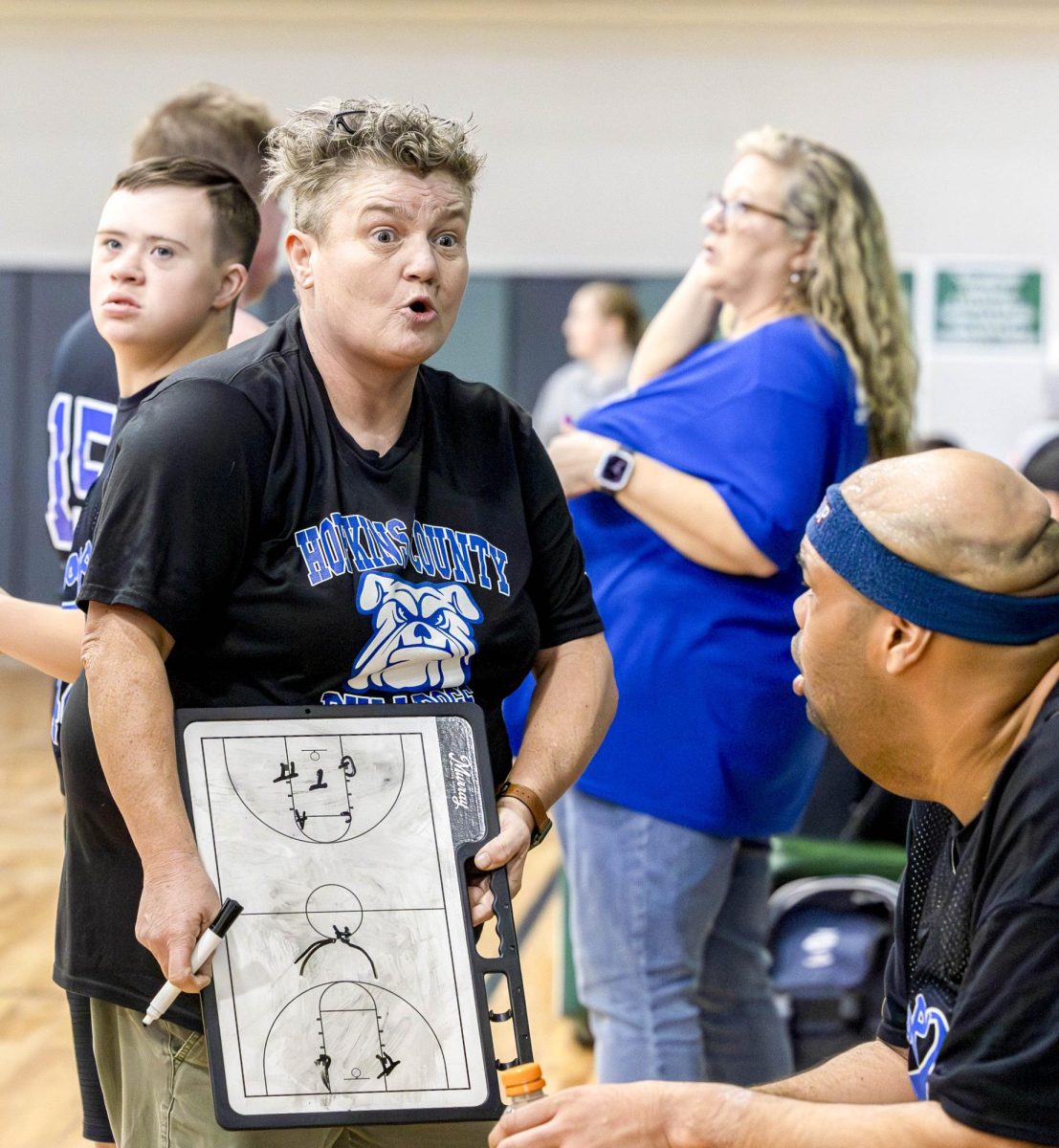

Trent began her involvement in Special Olympics Kentucky by volunteering.
“I started when I was 10 or 11, and then I just fell in love with it,” Trent said. “I kept going back and volunteering at every event I could, and then they offered me a full-time position.”
She said that, though it is difficult to get volunteers initially, the program’s volunteer retention rate is high.
“They want to keep coming back,” Trent said. “Our athletes are infectious. It’s not hard to be happy when you’re around them.”
Jason Hawkins said that Special Olympics athletes have the best sportsmanship.
“If somebody falls down, there’s probably five people going to pick them up from both teams,” he said. “It’s very wholesome.”

Trent said that families play a large role as volunteers in their local programs, and that she strives to support them and honor their advocacy for their children.
“They have spent their entire life advocating for their child and having to be that voice for them, so I want Special Olympics to be the one place where they don’t have to,” Trent said. “Their child is included the way that everyone else is.”
After winning his first game of the tournament, Lincoln Hawkins recited from the Special Olympics oath.
“Let me win,” he said. “But if I cannot win, let me be brave in the attempt.”