Editor’s Note: This story was first published as “Campus greenhouses in jeopardy” in Volume 101, Issue 4 of the Herald magazine.
Leaders of WKU clubs and programs that use the on-campus greenhouses returned to the Hill this semester to find the greenhouses fenced off — with no notice as to why.
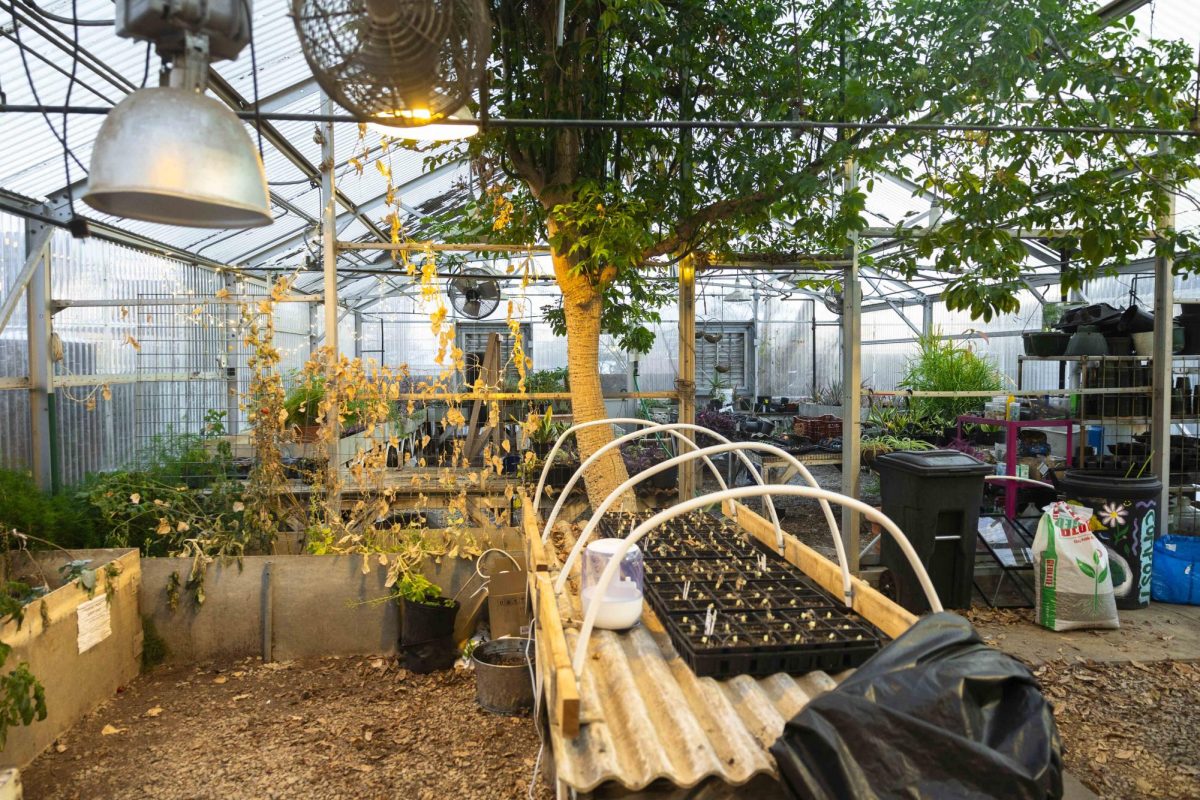
The greenhouses provide a space for students to get experience taking care of a diverse range of plant life. Both the Department of Biological Sciences and the Department of Agriculture & Food Science use the greenhouses as a space to teach classes on propagation techniques.
The university marked the campus greenhouses for destruction over the break. While no final decision has been made, the university plans to “evaluate the degree to which the greenhouses are utilized,” University Spokesperson Jace Lux said.
The evaluation will be done “primarily by reviewing the number of courses that have used the greenhouses and how often they have been used in recent years,” Lux said.
Brooke Meyer, president of the Ecology Club, secretary of the Horticulture Club and a senior biology major, said the greenhouses are “very actively used.”
“There was no true evaluation on how these spaces were used,” Meyer said.
David Brown, dean of the Ogden College of Science and Engineering, was not made aware of the plans to demolish the greenhouses.
“We were surprised to see them (the greenhouses) being fenced into the construction zone adjacent to the Environmental Science and Technology building earlier this month and to subsequently learn that they were slated for destruction,” Brown said.
The news came as a surprise to professors in the Agriculture & Food Science and Biological Sciences departments, as well as to the Ecology Club, which was working with its club advisor and Biology Professor Jarrett Johnson on making a pollinator garden this semester in the now fenced-off space.
“I think it’s disrespectful to both your student community and the professors in your department,” Meyer said.
The Horticulture Club has experienced a significant increase in attendance at its meetings since Meara Wilcox, the club’s president and a senior environmental science major, began her presidency during her freshman year.
The club hosts pottery painting nights, movie nights and game nights in the greenhouses. Students who utilize the greenhouses and members of the Horticulture Club are tasked with maintaining plants throughout the year.

Meyer said there was no communication between departments, with most finding out about its potential demolition when they encountered the greenhouses fenced off without access. Meyer first discovered news of the possible demolition from an executive board meeting for the Horticulture Club.
“I think the main thing that was frustrating for both myself and Meara was the fact that we heard about this through word of mouth,” Meyer said.
Wilcox first heard of the possible demolition around mid-January after her boyfriend discovered the gate around the greenhouses on his way to water the plants inside. She learned about the possible plans for demolition after inquiring about the fence to both the Agriculture & Food Science and Biological Sciences departments.
“It does seem almost out of nowhere,” Wilcox said. “I know, at least as a student, it’s not something I’ve even heard mentioned or talked about.”
For Wilcox, the space was used to display her passion for plant life to the members of her club.

“I love to share things I’m passionate about with other people, and it’s been a really great space for that,” Wilcox said. “I feel like I’ve made valuable connections with people in my department, and outside of my department, and have had a lot of hands-on time with plants.”
Wilcox felt disappointed and overlooked by the university after discovering that a place she had put a lot of her passion into was being demolished.
Brown remains in contact with the university to hopefully work out a compromise for the students and professors.
“After we informed central administration that the greenhouses are still in use, we were provided with gates in the fence to access them,” Brown said. “We continue to work with central administration on trying to find a positive long-term solution.”
Editor’s Note: Editor-in-Chief Jake McMahon and Assistant News Editor Kane Smith, who edited this article, are friends with quoted source Meara Wilcox.