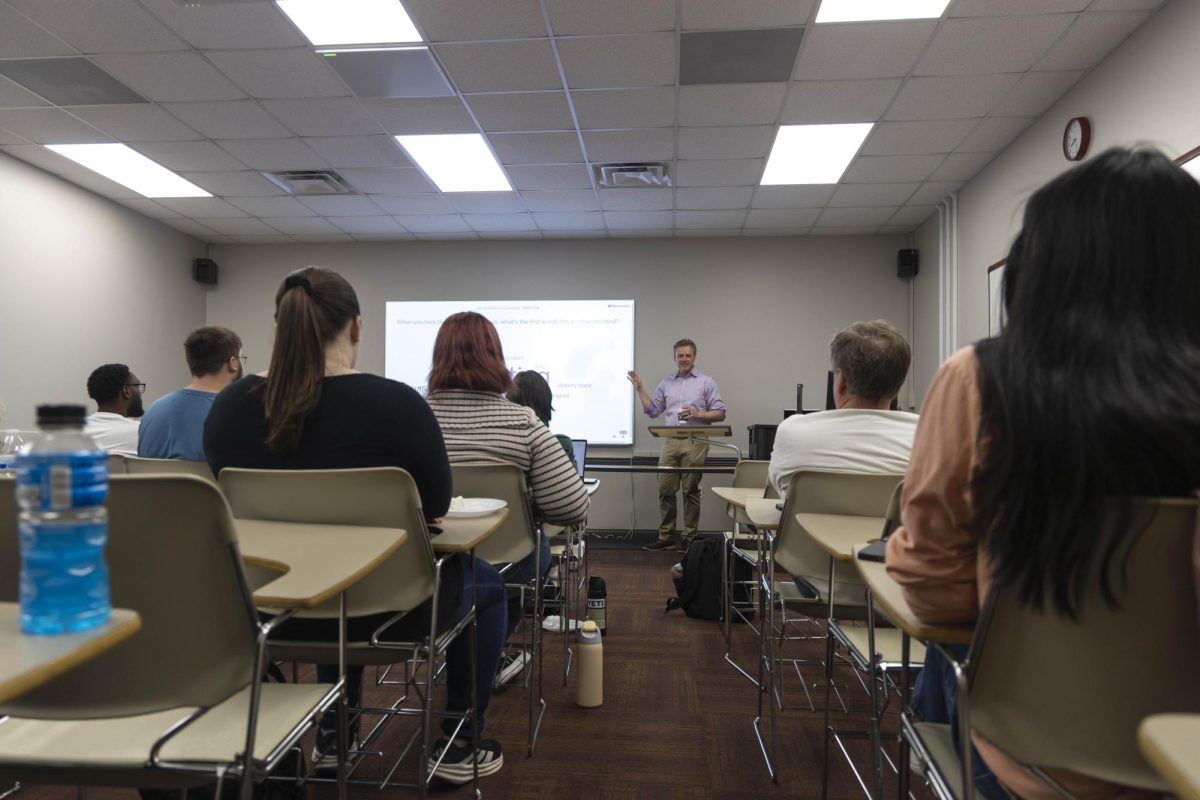
A classroom of curious students and faculty spent just over an hour learning about AI on Tuesday.
The first Brown Bag Lecture of the semester, “AI On Campus: What Students Need to Know,” was given by Kyle Maksuta, a criminology professor at WKU. Sponsored by the Potter College of Arts and Letters, the lecture aimed to inform students about what AI actually is and how it can be applied to education, in both productive and counterproductive ways.
Maksuta began the lecture by introducing himself and his experience with AI, but he didn’t describe himself as an expert.

“I’m into the space in that sense of trying to experiment with it, understand AI, and I also use and adapt it for my classroom settings as well, in ways that I hope at least enhance student experience,” Maksuta said.
Maksuta used a Mentimeter, a survey integrated into the slideshow, which allowed students to provide a word or two that first comes to mind when AI is brought up. Students input words such as: “crutch,” “unoriginal,” and “do not use.”
Maksuta addressed the negative thoughts around AI at the beginning of his lecture. He focused on economic worries and how AI may affect the job market.
“The reality is that all of us are kind of unsure about this in some way, shape or form,” Maksuta said. “And oftentimes, when we’re unsure about something, we tend to kind of side more on that negative side.”
In the classroom setting, “Educators certainly feel uneasy,” Maksuta said. He said he believes that while educators are apprehensive about AI, it can be used in the classroom by both students and faculty in productive ways.
Maksuta said if students input a prompt and take the AI’s first answer without analyzing the response, it leads to an overall lack of learning. Maksuta said using AI non-critically leads to a superficial understanding of the material and to developing fewer long-term memories. Maksuta said that in the process of using AI, workers and students often make themselves more efficient, but engage with their work much less.

Maksuta said AI should be used as a scaffolding tool. “The goal here is to foster independence, not dependence,” Maksuta said. If AI is simply used to get work done faster, “We’re depending on it at that point, which is a very, in my view, debilitating experience.”
Students expressed they never thought about using AI in a critical way.
“I did not know that there was such a difference in the type of people who can gain from it,” said Katie Dudgon, sociology major. “I always thought most people don’t gain at all.”
Maksuta also likened the rise of AI to the rise of search engines in the early days of the internet, when people didn’t yet realize its functionality as more than a shortcut.
Maksuta concluded his remarks with an emphasis on the choices students make concerning their education. Maksuta said part of responsible usage of AI is “self-regulation.”
“If it makes life easier for people, they’re going to use it,” Maksuta said.