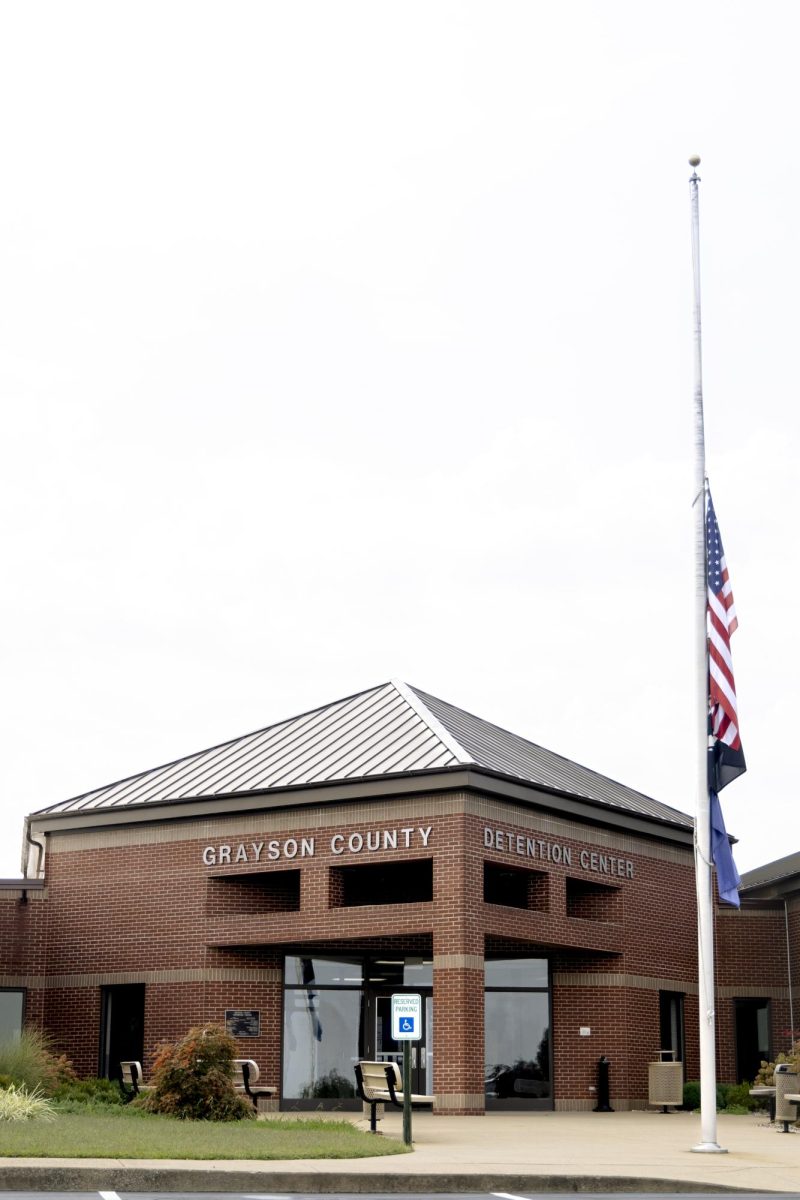
When Immigration and Customs Enforcement incarcerated Gladis Yolanda Chavez Pineda, a Chicago mother and organizer with Organized Communities Against Deportations, the Kentucky jail that held her could barely make room.
ICE arrested Chavez Pineda for her asylum-seeking status and transported her to Grayson County Detention Center on June 11. She recalled people sleeping on concrete floors with just one mattress for a group of 20 people, and a single bathroom for 20 or more detainees with no privacy partitions, according to information her daughter provided to CBS News.
Kentucky Revised Statute 441.055 establishes minimum standards for jails that house state prisoners. The statute requires one toilet, sink and drinking fountain per 10 inmates, and one shower per 20 inmates. The statute also requires 40 square feet and one bunk for every detainee.
Chavez Pineda isn’t alone in her detention experience. Kentucky inmates are being housed in increasingly overcrowded conditions as county jails contract with ICE to hold its detainees.
President Donald Trump signed Executive Order 14159, “Protecting the American People Against Invasion,” on Jan. 20. The order added Section 287(g) to the Immigration and Nationality Act, which allows the Department of Homeland Security to partner with state and local law enforcement agencies, like county jails, and assist in ICE operations.
Grayson County Detention Center entered an agreement with ICE in March. The facility’s contract guaranteed five beds to be used for ICE detainees. As of April 13, 2025, the detention center housed 98 ICE detainees, according to Transactional Records Access Clearinghouse.
The Kentucky Department of Corrections’ (KDOC) weekly jail count sheet from Sept. 4 reported the facility as 136% overcrowded with 729 inmates to 536 beds. Grayson County’s jail has the third-largest inmate population in Kentucky, following Fayette (Lexington) and Jefferson (Louisville) counties.
The sheet categorized 32 jails as over capacity and two jails at exact capacity out of 120 total detention facilities in Kentucky as of Sept. 4.
Kentucky legislation heightened penalties and lengthenedv sentences for criminal charges, creating more inmates. These laws include the 1974 Penal Code, the “Three Strikes Law” and the “Safer Kentucky Act.” When state prisons fill up, state prisoners overflow into county jails.
The state implemented per diems, a daily payment to county jails to cover the cost of incarceration for housing state prisoners.
Citizens and activists are concerned that jails contracted with ICE have an incentive to overcrowd to receive more revenue in per diems, leading to worsening conditions for immigrant detainees.
The Kentucky Citizens for Democracy in Grayson County hosted a town hall meeting on Sept. 4 to address “the profit incentive behind Grayson County’s overcrowding of their detention center with ICE detainees,” according to its website.

Michael Slider founded the group with his wife in February after Trump began his second term. They hosted the first meeting in their basement in Oldham County. Now, after growing their membership, the group meets in a church and added a Grayson County chapter.
“We know these are hard conversations to have,” Grayson County Chapter Leader Beth Mattingly said. “We know that even acknowledging the facts makes people uncomfortable, but we also know that we have the moral obligation to speak out.”
Kyle Ellison, a former KDOC probation and parole officer and longtime prison rights advocate, said this was the most engagement he’d seen.

“People are interested because they totally understand that these people are not criminals,” Ellison said.
Ellison and Slider spoke at the town hall. Ellison came prepared with a data-packed slideshow full of resources, news articles and court cases.
“I have been following corrections issues for more than 50 years,” Ellison said at the town hall. “Even after I quit in 1988, I stayed mad.”
Slider asked moral questions, recited emotionally charged court cases and discussed his own religious and personal values.
“The problem is, an immoral and unjust system poisons everything that it touches,” Slider said. “So let’s call these detention centers, and let’s start calling them out for what they’re doing. It must become a badge of shame.”
Added per diem revenue given to jails holding state prisoners detracts from the amount jails need from county taxpayers.
The cost to incarcerate a state inmate is $89.02 per day, while the cost to incarcerate for county jails with state inmates is $56.51 per day, according to a KDOC report for the 2025 fiscal year. County jails without state inmates pay $46.51 daily. Per diems from the state help cover these costs.
The KDOC per diem to the jail is $36, while the federal per diem is $65.
“The state inmate count is down, which is a good thing for (the) state of Kentucky and the citizens in it… but it also means far less revenue for the jail,” Hopkins County Jailer Mike Lewis said in a May 8 WKMS article.
“So how do jails pay for all this?” Ellison said. “Well, one way to do this is you overcrowd your jail.”
On Aug. 21, at 142% capacity, Grayson’s detention center brought in $43,836 from per diems. The jail received $27,778 while at 100% capacity on June 20, 2021, according to KDOC. These amounts do not account for inflation or change in per diems over time.
Federal authorities negotiate per diem amounts with each jail individually, so amounts may vary, Ellison said.
The number of state and federal prisoners held in Grayson County increased from 477 on June 20, 2021, to 686 on Aug. 21, 2025. Less than 100 inmates held for local police and courts populated the jail on both dates.
Ellison said state prisoners should be in state facilities because prisons are built for long-term incarceration and have more space for separation of prisoners and education opportunities.
“The parole board wants to see that the inmate took programs and tried to improve himself,” Ellison said. “Well, those programs aren’t available in a jail. The likelihood of making parole is better if you’re in prison.”
Warren County Regional Jail does not have any contracts with ICE, but does hold state and federal prisoners. The jail is also overcrowded. A KDOC inspection report from June 16 found the jail overcrowded in 15 dorms, one cell and one dayroom.
The inspection listed 469 inmates, but only 410 beds. Some beds were also left empty, leaving 87 inmates to sleep on the floor, according to the report’s breakdown of each cell, dorm and dayroom.
The order of corrective action from the department required the jail to submit a “plan to correct non-compliant item” and a “time frame within which the item will be in compliance.”
Warren County Jailer Stephen Harmon’s written plan to the Division of Local Facilities included neither.
“We are overcrowded and have been for several years,” Harmon stated. “The corrective action is to continue monitoring cells and housing units and to adjust cell designations as much as practical, however, this is mostly out of our control.”
“The plan reflects a good-faith effort to comply with the standards and has been accepted as submitted,” the division stated in its reply to Harmon. “Thank you for your continued cooperation.”

Citizens asked Warren County Sheriff Brett Hightower if his department participated in the 287(g) Program.
“Here in Warren County, we stay so incredibly busy just with day-to-day operations that we really don’t have the additional manpower,” Hightower told the Herald.
The sheriff’s department is not contracted with ICE, but Hightower still reached out to ICE’s regional supervisor to establish a line of communication following the arrest of Ernesto Manuel-Andres, a Bowling Green teenager.
ICE detained Manuel-Andres at Grayson County Detention Center following his arrest on June 4 in Warren County.
At the time of his arrest, his residence in the U.S. was protected under the Deferred Action for Childhood Arrivals program and his special status as an immigrant juvenile for survived abandonment or abuse.
Reports of his arrest spread through the Bowling Green community, inciting public outcry, protests and vigils.
Manuel-Andres was transported three times in five days. He was released on June 24 from a detention facility in Monroe, Louisiana, and was met with celebration upon his return home.
“There wasn’t really a communication between them and us,” Hightower said.
Hightower said he and local citizens share concerns surrounding ICE operations. Hightower said that knowing the whos, whys and whens surrounding detainments would ensure those making the arrests have the appropriate federal credentials and quell uncertainty.
“We built these lines of communication, there’s been feedback and there should be a little more clarity,” Hightower said.