
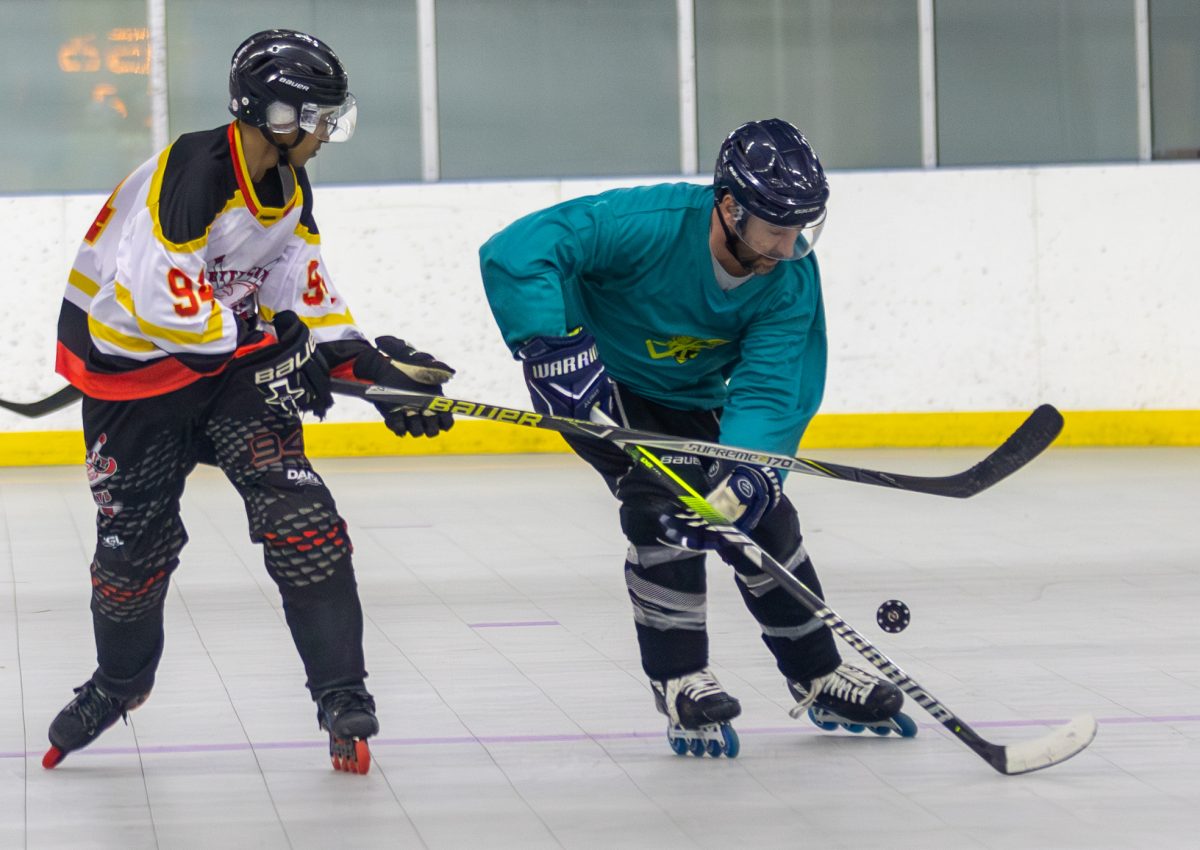
WKU’s inline hockey club is looking to get rolling again after a 20-year hiatus.
Nestled between the National Corvette Museum and the Corvette plant, a small team is trying to bring hockey culture back to the community. Dylan Kimbro, a Bowling Green native who grew up playing hockey, played roller hockey at Bethel University until he graduated in 2013. Kimbro saw the lack of hockey on WKU’s campus, but he noticed the interest in the community.
Kimbro started Ken-Tenn Sports, LLC., a company he started to help propel the two hockey clubs he already heads, and began leasing the Victory Sportsplex with SKY Soccer Club in August 2025. He owns the rink the players skate on, which is made up of indoor “sport court” tiles, made of polypropylene.
Kimbro owns the Vette City Hockey Club and the Vette City Stingrays. The Vette City Hockey Club is the youth program that Kimbro leads, and the Stingrays are the competitive team. Kimbro played for the Stingrays when he was a kid in the early 2000s.
Kimbro doesn’t work alone. Soon-to-be WKU graduate student John Klein went to Maryville University for inline hockey. Klein was the team’s captain at Maryville and represented the USA at the South American Inline Hockey Invitational in Brazil, where the team won gold.
Kimbro and Klein hope to start a new club team next year, when the collegiate season begins. They want to create enough interest through the rest of this semester to complete a co-ed team able to compete in tournaments next year. They only need 10 people.
“We do have a couple of people who are already enrolled that are interested that have actually played in my tournament here,” Kimbro said.
Once a club has started and is enrolled with the NCRHA, the hope is to start at the DIII level, the lowest division of roller hockey—but climbing the ranks comes with time. It also comes with having the right players.
Klein is the leader of the program right now, but Kimbro said, “that’s not really who’s gonna carry the program.” The players who can get four years are the ones that Kimbro and Klein are after.
WKU’s original club inline hockey team started in 2002 and played on an outdoor rink at a public park. Ryan Murphy, who played on the original club team and graduated from WKU, said there were about 15 people who laced up their skates at game time. They started with tournaments in Clarksville, Tennessee, and Bowling Green.
In 2005, thanks to club president Eric Diego, the team joined the National Collegiate Roller Hockey Association and began competing in a division in Raleigh, North Carolina, before moving to a division in St. Louis, Missouri. The team was DI in the NCRHA for the inaugural year.
Murphy and most of the team graduated from WKU in 2007. In their absence, the team didn’t have enough members to keep going. As an official club sport, the team played two-and-a-half seasons and became DIII by the time the team disbanded.
“If we would have had a place like this (Kimbro’s rink), this was what was holding our program back, there’s a lot of good hockey players at Western that didn’t want to play on an outdoor concrete makeshift rink. What we were missing was this,” Murphy said.
A lack of mentors was one of the reasons the team at Bethel folded, along with a funding cut. Once alumni graduated, they weren’t so present for the team.
“And I think that’s obviously something we can learn from,” Kimbro said.
Murphy said roller hockey teams can often be “what draws people to the school.”
“Kids will travel and once they get bit, they’ll pretty much do anything they can to meet the level that they wanna play,” Kimbro said.
Cost keeps inline hockey inaccessible. Skates cost hundreds of dollars, and so do sticks, and then there’s tape and all the other things that come with being a hockey player.
Kimbro, Klein and Murphy know that’s what’s holding most kids back from joining. It’s also what’s holding college students, notoriously known for being broke, from joining.
Murphy believes that if travel, at a minimum, were paid for, students would flock to the club. The inclusive nature of a club sport makes it more appealing too. Kimbro already has a slew of donated equipment that he lets players in both his leagues borrow.
The club, to Kimbro, gives all players a chance to play. The ones who don’t think they have a chance, the ones that do, the ones who just want to play for fun. Kimbro’s arms are wide open to anyone who wants to join, but the final intention is to create a team that wins.
“I think our sport can be very intimidating at times. You know, it’s ‘oh, I can’t skate!’ Like how do I—oh, I’m not gonna give it a chance,” Klein said. “But, I mean, really the community’s really special, because it’s tight-knit and I mean, mostly, everyone is super happy for anyone to get out there and give it a try or go and learn.”
Murphy sees a future of hockey in Bowling Green. The proximity to St. Louis, an inline hockey giant, makes Bowling Green a tournament “hotspot.”
Kimbro has the gear waiting for the next all-star to pull it on.
If interested in joining the WKU inline hockey team, contact Kimbro at [email protected].
