A packed crowd at The Capitol Arts Center on Sunday watched “Jonesville: When Sunflowers Fall” and then encouraged WKU to reckon with the Black neighborhood it helped erase.
The documentary traces the history of Jonesville, a community founded by African American Civil War veterans that stood just off WKU’s hilltop campus until it was seized and demolished during the urban renewal era. For many in the room, it was the first time they had seen Jonesville not as a footnote, but as a place with faces, names, homes and businesses.
“This was a neighborhood, a community, and it’s really sad what happened,” said Bowling Green resident Cayce Johnson, who described the film as something “everyone in Warren County should see.”
From the stage, historian Davarian L. Baldwin pushed the audience to see Jonesville as part of a national pattern, not an isolated local tragedy. In his research on universities and urban development, he said he kept finding stories like this: campuses that now function as “univer-cities”, major employers, landlords, health providers and even policing forces, in place where they once helped clear Black neighborhoods labeled as blighted.
“Univer-cities” is a term Baldwin uses to describe how some universities now function almost like city governments or city-sized powers, not just schools.
“Urban renewal is often remembered through highways and housing projects, but what is almost always absent from public memory is the role that colleges and universities played and how they became the friendly face of demolition and displacement,” Baldwin said.
In Jonesville, that role ran through federal urban renewal programs, especially Section 112 of the Housing Act, which allowed cities to condemn land and then transfer it to universities. Baldwin and local researchers said Bowling Green used that authority to acquire Jonesville and then turn it over to WKU.
Former WKU President Gary Ransdell, who served from 1997 to 2017, told the audience that just over $1 million in federal, state and local funds was spent on the project, with the university paying about $212,000 for land that now holds E.A. Diddle Arena, Houchens-Smith Stadium, baseball and softball complexes and other campus buildings. He learned much of the detailed history only after leaving office, calling it “an important chapter” he had not fully considered during his tenure.
The film and panel both emphasized what the price tag in the project left out: the lives built in Jonesville over generations, and the wealth and stability that vanished with the bulldozers.
Families ran small businesses, owned multiple properties and raised children in what the son of former resident William E. Alexander, who is turning 102 years old in May, remembered as “the most beautiful place I’d ever lived…a family atmosphere” where neighbors looked after one another’s kids.
Artist and Bowling Green Human Rights Commission Director Alice Gatewood Waddell grew up visiting her great-grandmother’s home there. Deeds show her family owned several properties in the neighborhood, and Sunday dinners in Jonesville were a fixture of her childhood. She said losing the land ended any chance to pass that equity on.
“That was the end of generational wealth,” Waddell said. “People were not given enough money to pass down to generation to generation.”
Attorney and Jonesville descendant Akisha Townsend Eaton traced her family’s presence in Jonesville back to at least 1880. They owned a grocery store, a tavern and several homes. Her great-grandmother refused WKU’s first offer and took the case to court, eventually receiving more than the university initially proposed, but still far less than what the properties would have been worth over time.
During research for the film, Townsend Eaton uncovered her great-grandmother’s eviction letter. Even for families who found other places to live, she said, the process “was very devastating,” and many never recovered economically or emotionally. Some Jonesville houses were put on trucks and moved to other parts of Warren County, where a few still stand today as physical evidence of the uprooted community.
Audience questions focused on what happened to residents after they were forced out and whether anyone resisted. Panelists said many families were pushed into public housing, neighborhoods such as Shake Rag, Delafield and Kenton Street, or out of Bowling Green altogether. City Hall meetings at the time were packed with Jonesville residents and allies, Townsend Eaton noted, and Black and white community members spoke against the clearances.
“The resistance is something that really is an overlooked aspect of this,” Townsend Eaton said. “It looks like everybody lost, but the fact we didn’t just run away with the first offer really mattered.”
Speakers said that today’s athletic revenues, real-estate portfolio and half-billion-dollar annual economic impact in the region are rooted in land acquired from Jonesville at discount prices. Contractors, business owners and surrounding counties have all benefited, they said, from prosperity “seated in the ground” where Jonesville once stood.
“Today’s prosperity didn’t come from nowhere,” Baldwin said. “It came from theft. All those who have sacrificed for it should also rise and prosper.”
Greer, who helped produce the documentary with Waddell, Townsend Eaton and partners at WKU PBS and the Kentucky Folklife Program, called Sunday’s screening “the beginning of another conversation” about what the city, university and business community owe Jonesville descendants.
Across the country, Baldwin said, some communities have already used historical research to push institutions and governments beyond plaques and apologies. In West Philadelphia, old maps and property records from the 1960s Black Bottom neighborhood showed how universities and the city had promised replacement low-income housing that was never built. Activists used that evidence to win Philadelphia’s first rule forcing new University City projects to include affordable units.
In Athens, Georgia, descendants of the Linnentown neighborhood, demolished for University of Georgia student housing, wrote their own resolution calculating that the loss of homes and land would equal about $5 million in today’s dollars. The university rejected their call to split the cost, but the city agreed to contribute $2.5 million to a fund run by descendants, who are using it to seed affordable housing and a planned Athens-Clarke County Center for Racial Justice and Black Futures.
Denver’s Auraria campus offers another model. There, a largely Chicano neighborhood was cleared in the 1970s to make way for a higher-education complex shared by multiple institutions. After years of organizing, Baldwin said, displaced residents and their families secured a preserved section of the old neighborhood on campus, a peace and healing garden and full scholarships for descendants in perpetuity.
“With the story of Auraria, it shows us that repair does not have to live at the margins,” Baldwin said. “It can and should sit at the center of the prosperity that is seated in the institutional life of the campus and its community.”
Baldwin told the audience that WKU and local leaders could take similar steps without waiting for new federal laws. Ideas he outlined included reserving open seats in certain classes and academic programs for Jonesville descendants, setting aside campus jobs and internships, turning surplus dining-hall food into prepared meals for families in need and placing part of the university’s investments in community-based financial institutions that serve historically displaced neighborhoods.
“This isn’t rocket science. It’s not revolutionary,” Baldwin said. “It’s identifying the points of leverage in the currently existing institution and finding out ways in which it can be inclusive for all.”
Ransdell cautioned that most of WKU’s endowment funds are legally restricted to specific uses such as scholarships, faculty chairs or capital projects. But Baldwin countered that future capital campaigns can be designed with Jonesville in mind: universities choose what they ask donors to support, he said, and could decide to make Jonesville repair one of those options.
“In the next capital campaign, why don’t we say, ‘Let’s create a fund for Jonesville repair and have it restricted to that work’?” Baldwin said.
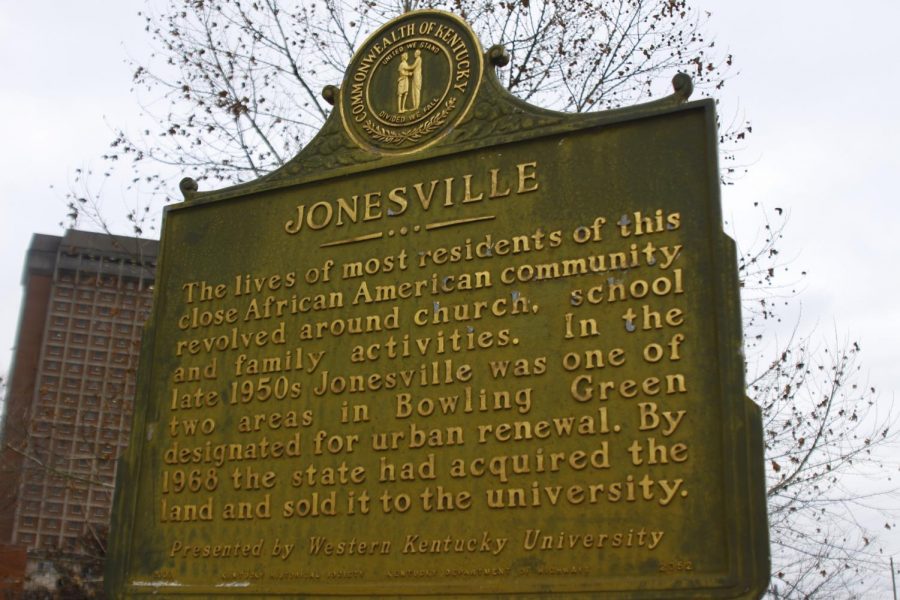
There are already small signs of institutional recognition. A state historical marker now stands near Russellville Road along the edge of campus, close to one former boundary of Jonesville. WKU President Timothy Caboni has convened a Jonesville Reconciliation Work Group led by retired administrator Peggy Crowe, and the Kentucky Museum and Kentucky Folklife Program have partnered with descendants on exhibits and programming.
Greer said the descendants group is now a fiscally sponsored project preparing to accept tax-deductible donations for future educational and community events. He urged residents and organizations interested in screenings or policy discussions to reach out through an email address dubbed “Sunflowers4Jonesville,” echoing the film’s title.
As the afternoon ended, Greer and Townsend Eaton said Sunday’s event was only a first step. The documentary is now available on YouTube, and organizers hope it will be used in local classrooms, churches and civic spaces as they press for scholarships, memorials, housing initiatives and other forms of structural change.
“The question before us is not whether Jonesville will be remembered,” Baldwin said. “It’s whether the history will be transformed into action.”