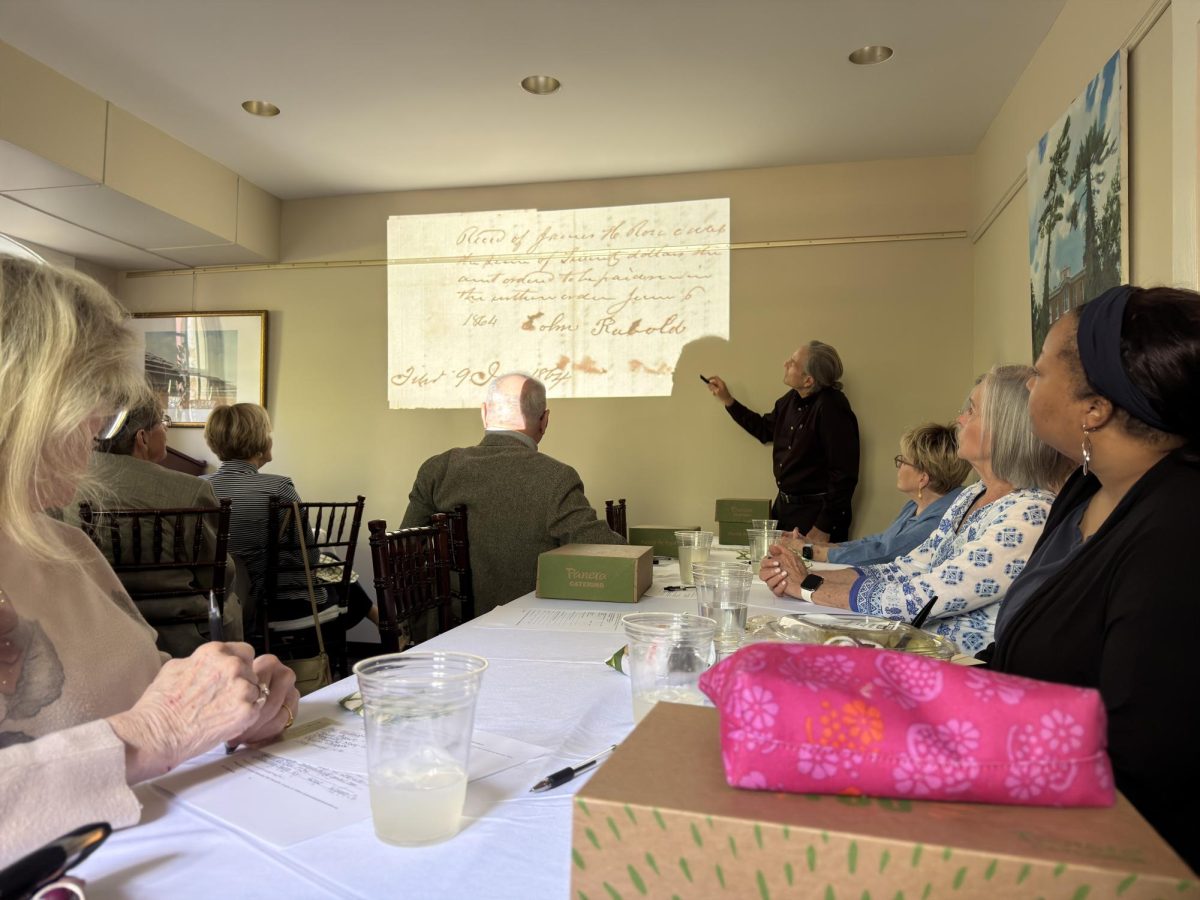
Author Stephen Allten Brown presented excerpts from the history of American chattel slavery and the stories of those who escaped it with a Sunday afternoon audience at the historic Hobson House.
The event was the third and final in the spring lunch and learn series hosted by Riverview at Hobson Grove Historic House Museum. Prior events taught audiences about the histories of the Kentucky Derby and the American Revolution. Sunday’s event focused on chattel slavery and the Underground Railroad.
“I love to see people’s eyes light up when they make connections,” Brown said. “It’s wonderful to hear their own stories and how they relate, or that they ask a question that shows they’re listening, thinking, making connections… to see people understanding and learning is such a treat.”
Brown’s historical fiction romance novel “A Promise Moon” followed a young, enslaved woman who carries her infant son through her journey to freedom from the antebellum U.S. South, and her husband’s quest to join them.
Brown said his novel drew from the Slave Narratives project, which was conducted by the Works Progress Administration in the 1930s as part of President Franklin D. Roosevelt’s New Deal programs.
“I realized that these were heroic stories of resourceful, incredibly brave people,” Brown said. “There were some exceptions, obviously, but for the most part, the escapes were unaided.”
Brown said the Underground Railroad was a secret network of passages and stopping places for those escaping slavery that crisscrossed the northern United States before and during the Civil War.
“There were some remarkable people, who really didn’t get anything out of it, other than a sense of doing the right thing,” Brown said.
Brown, a native of New Mexico, said he became more familiar with the stories and systems of American slavery when he worked for the National Park Service in Washington, D.C.
The United Nations General Assembly passed a resolution March 25 that declared the “trafficking of Africans and racialized chattel enslavement of Africans as the gravest crime against humanity,” according to German outlet Deutsche Welle.
The United States imported at least 400,000 of the more than 12 million African slaves trafficked across the Middle Passage of the Atlantic Ocean, according to the Slave Voyages Consortium.
“Slavery was economics, it was about money, and people don’t realize how big the money was,” Brown said. “About half the net worth of the South was tied up in slavery. That’s mind-blowing — I didn’t learn that in high school.”
Brown displayed official ledgers from Warren County for returned fugitive slaves, who were legally considered “contraband.”
Brown’s ledgers showed bounties for runaway slaves could amount to $100 or more, roughly equivalent to a year’s income for many. Others, including the sheriff, jailer and county clerk, also received large kickbacks, sometimes worth more than what the catcher got, according to Brown.
The Underground Railroad was developed by sympathetic free citizens in defiance and subversion of the Fugitive Slave Acts, which developed the legal framework to promote and enforce the return of runaway slaves.
The fine for aiding a “fugitive” slave could be as much as $1,000, making such a decision a potentially massive cost.
“A lot of people would like to say, ‘Of course I would have assisted a person,’ or, ‘Of course, I would have taken the opportunity to become free,’” local attorney Akisha Townsend Eaton said.
Eaton said she’d like to think she would have fought to be free, but emphasized the sacrifices of those who ran the gauntlet to freedom, including physical and emotional tolls.
“That needed to be considered, whether or not I have the physical ability to withstand such a journey,” Eaton said. “Being an enslaved person was very physically laborious. It would be a very difficult decision with life-or-death consequences.”
Eaton, who considers herself a “citizen historian,” believes learning history prompts questions about challenges faced today.
Eaton helped to produce the documentary “Jonesville, Where Sunflowers Blossom,” about the Bowling Green community where her family resided as early as 1880. Jonesville was a Black community established by former slaves around 1880, according to WKU.
Brown explained that most escapes came during winter nights, since most others —slaves or slave holders, catchers, etc. — were more likely inside.
Bodies of water like the Ohio River froze over, which made them passable on foot.
“Sadly, the enslavement of Africans and how horrific it was to escape is part of American history,” said Riverview Executive Director Brooke Peterson. “To hear about the hardships and know that those are real stories about real people…it’s very inspiring and sobering.”
Brown gave the example of Presbyterian minister John Rankin, who the National Abolition Hall of Fame and Museum called “one of the nation’s best-known Underground Railroad Conductors.”
Rankin, a white southerner, began to preach in 1817 the sinfulness of slaveholding in his home state of Tennessee. Discouragement from church leadership and a combination of safety and financial concerns pushed Rankin and his family north through Kentucky to settle in Ripley, Ohio.
In 1824, Rankin learned his brother had become a slaveholder and wrote a series of letters that would become one of the earliest and most effective published works against slavery. Rankin and his family worked with African American John Parker to turn Ripley into a key crossing point over the Ohio River for approximately 2,000 runaway slaves.
“It’s a shame that people think history is boring,” Brown said. “We’re still learning and there will always be more to learn…It’s very changeable, it’s often misunderstood, and we’ve come very far.”