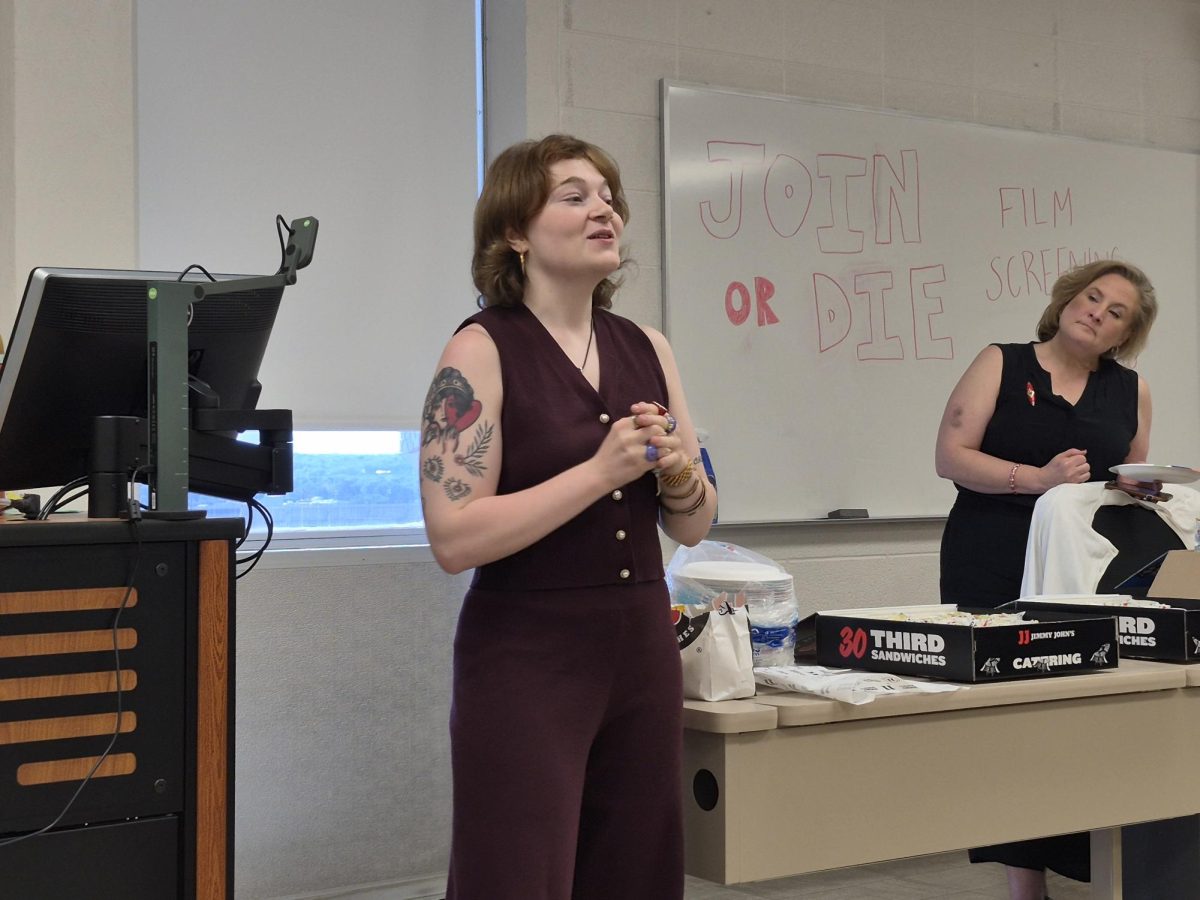
WKU’s screening of “Join or Die” showed the importance of civic engagement and encouraged students to take a more active role in campus and community life.
The Wednesday event brought together students, faculty and organizers to talk about why participation matters and what can happen when people stop showing up for their communities.
Sponsored by the American Democracy Project on campus, “Join or Die” is a documentary centered on the decline of civic and social participation in the United States. Drawing on the work of political scientist Robert Putnam, the film argues that when people stop joining clubs, community groups and other organizations, trust, connection and democratic participation begin to weaken.
For Vivian Carlson, a student worker in WKU’s Department of Political Science, the film’s message felt urgent. Carlson said students are living in a time of low civic engagement, a trend she believes affects both government and everyday community life.
Rather than framing the issue as abstract or distant, Carlson pointed students toward practical ways to get involved, including extracurricular activities and the department’s effort to revive the Political Science Club.
“The big takeaway would be that political engagement and civic involvement is a really crucial part of living in American society,” Carlson said.
Carlson said colleges should help students understand responsibility and create more opportunities for involvement, including voter registration drives.
Crystal Bohlander, part-time professor and a representative for the Department of Society, Culture, Crime and Justice Studies and a supporter of the American Democracy Project on campus, said the screening was designed to help students see participation as both meaningful and personal.
“We are very interested in finding ways to promote civic engagement among our students, and this documentary is a wonderful way for students to understand the value of their own participation,” Bohlander said.
That sense of participation, Bohlander said, matters at a time when many young people feel disconnected from one another. Bohlander pointed to division in the country, changing communication habits and the lingering effects have become harder to sustain.
As more communication happens online, Bohlander said, students may miss chances to build confidence in face-to-face interaction and collaboration.
Bohlander encouraged students to start small: look through WKU’s registered student organizations, talk with faculty members about starting a new group, or connect with local nonprofits tied to causes they care about.
Josiah Watson, a junior majoring in political science and social work, said the event was also connected with his own efforts to help revive the Political Science Club.
Watson said the film reflects a larger national problem: fewer people are joining organizations, and that loss weakens the country’s social ties.
“When people are socially engaged, they’re more likely to be civically engaged,” Watson said. “They’re more likely to vote. They’re more likely to attend local government meetings.”
Watson said the decline does not just affect campus life. When people stop attending school board meetings, zoning meetings and city council meetings, public officials have a harder time understanding what their communities need.
Watson said universities play an important role by supporting clubs and student organizations that give people a place to connect, organize and participate.
“The nation won’t succeed if people aren’t joining social organizations,” Watson said.