The location of the Faculty House “significantly impacts” accessibility routes to and around Cherry Hall for those with mobility limitations, according to an assessment sent June 9 by Champlin Architecture and EOP Architects.
WKU President Timothy Caboni announced at convocation in August that a committee will be appointed this year to explore alternative options to tearing down the Faculty House after its demolition was paused because of community outcry in May.
Three options are currently being considered for the Faculty House, according to the assessment. These options are keeping the building in place, relocating the building as one structure or relocating the building by dissembling it and reconstructing it somewhere else.
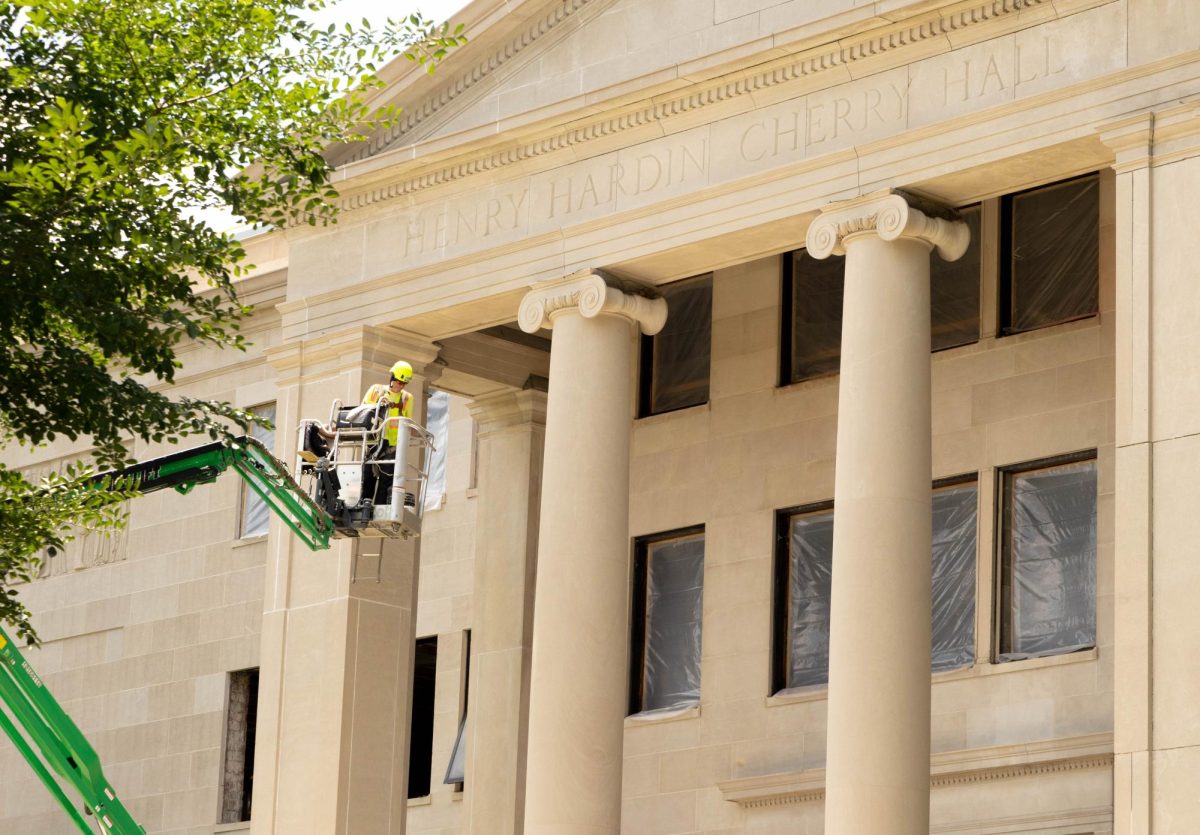
The assessment stated that in the process of renovating Cherry Hall and the “associated removal of the 1970’s-era entry vestibule and elevator tower additions” on the rear of the building, it’s necessary to regrade the entirety of the inner courtyard to accommodate access to the building’s entry for those protected under the Americans with Disabilities Act. The building’s entry will now be located at ground level, according to the assessment.
“The current location of the Faculty House significantly impacts the ability to get the gradual slopes necessary to accommodate those with mobility limitations into and around Cherry Hall,” the assessment stated. “Any decisions taken to maintain the Faculty House in its current location will necessitate reconsideration of the design approach for these changes to Cherry Hall, and alternative approaches will need to be considered.”
WKU Spokesperson Jace Lux said in an email that enhancing accessibility to the rear of Cherry Hall depended heavily on removing the Faculty House under the current plan designs. He said that “one of the only noticeable changes” to the front of Cherry Hall is the addition of a ramp to the front of the building for accessibility purposes.
If the committee decides to keep the Faculty House where it is, the design team has been asked to develop an alternative plan to make sure the project remains on schedule, Lux said.
“As the assessment makes clear, the Faculty House’s current location creates substantial challenges to improving obstruction-free access to Cherry Hall, a building used heavily by students, faculty, staff and visitors,” Lux said. “While I can’t speak on behalf of the committee, I expect that obstruction-free access to Cherry Hall will be one of the most significant factors guiding their review.”
When asked why WKU didn’t stress to the public the impact the Faculty House’s location has on ADA accessibility, Lux said the university wanted to present to the public all the issues under consideration, rather than suggesting that a single issue would determine the building’s future.
“We recognize that the Faculty House holds deep sentimental and historical significance for many in our community,” Lux said. “For that reason, we felt it was important to present the full range of complex factors under consideration rather than suggesting that a single issue — such as accessibility — would determine its future. That said, accessibility is a critical concern.”
While the Faculty House may be able to be repaired where it stands “in kind or with temporary bracing” to maintain its overall stability, it wouldn’t be viable for use by the university without some level of repair or alteration, according to the assessment.
Further investigations will also be necessary to determine if the building qualifies for any historical building exemptions, which could make it possible to waive certain building code requirements.
The assessment stated that some of the existing structure could remain in place unmodified, depending on the level of repair or alteration required for the potential renovation. It is likely, though, that “a significant portion” of the building structure will need some amount of reinforcement to meet current-day code.
“Depending on the level of alteration to the building to meet the University’s needs, the code may not require the full building to be brought up to the current code,” the assessment stated. “However, further review and analysis of the existing structure can be performed to aid the University in deciding whether voluntary upgrades should be made for safety.”