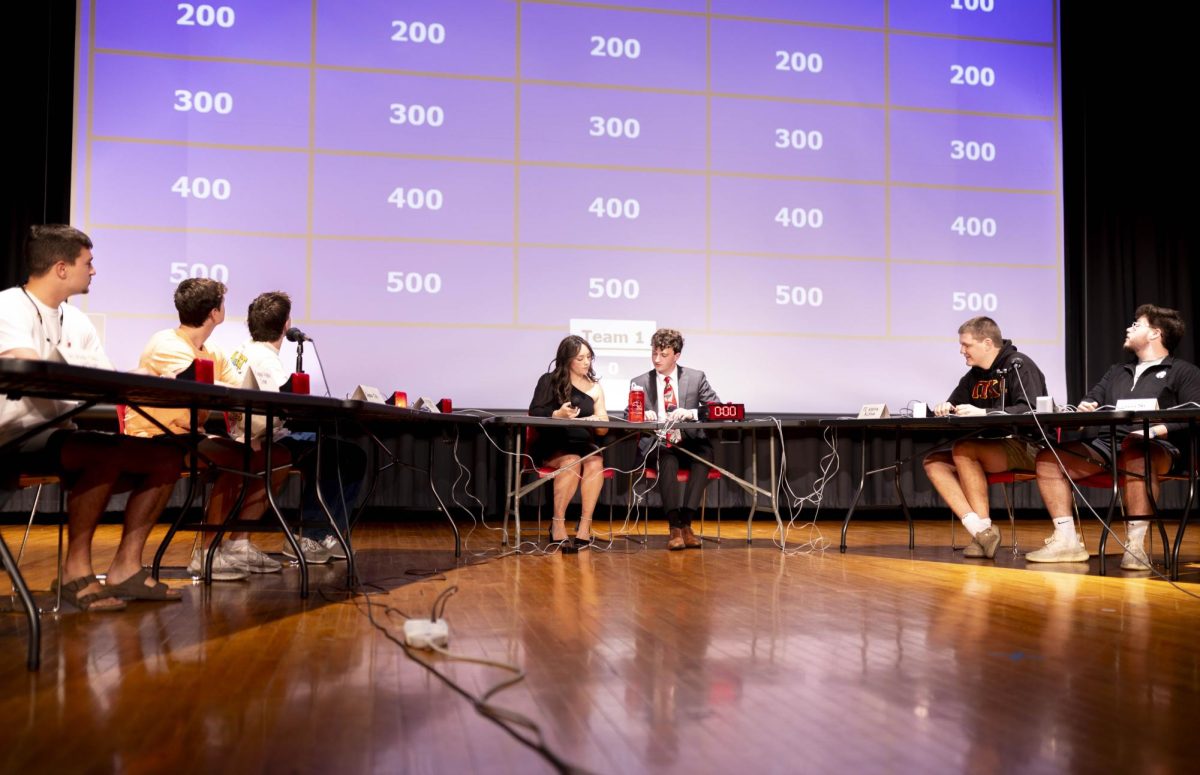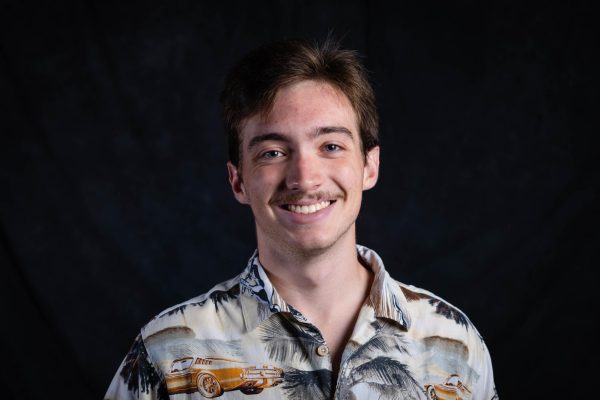
WKU Forensics team members showcased award-winning speeches for the community Tuesday in Ogden Auditorium.
The team is nationally and internationally acclaimed, with accolades and record-setting achievements stretching back to the early 2000s.
“WKU is the only team to ever win the AFA NST (American Forensics Association National Speech Tournament) Team Sweepstakes Championship, the NFA IE (National Forensics Association Individual Events) Team Sweepstakes Championship, and the NFA LD Team Sweepstakes championship in the same season,” the forensics webpage stated. “In 2021 WKU accomplished this feat for the ninth time… since 2004.”
The team won every in-person tournament they have attended this semester, and just finished competing for a national tournament last week.
“Showcases are always nice, because a lot of times we exist in our little speech bubble,” said Jade Ismail, a junior majoring in biochemistry and psychological science. “But with opportunities like these, we get to go out in the community and show people what we do.”
Ismail said she noticed parents, instructors and other people non-affiliated with the speech team in the audience.
Hayden Johnson, a freshman exercise science major, said the showcase was equally helpful for fellow members of the team who may not have seen their teammates’ performances.
Kilian Reck, a freshman mechatronics engineering major, joined Johnson in emceeing the showcase, explaining forensics and introducing each speaker.
Forensics includes four types of events that students compete in: platform or public address, interpretation, limited preparation and debate.
No limited preparation speeches were demonstrated at the showcase, but Johnson and Reck explained the concept. Speakers “who like to think on their feet” are given a prompt, Reck said. They then have a limited amount of time to prepare and deliver a speech based on the prompt.
Kirsten Eversmann, a senior majoring in criminology and sociology, started the night with a platform or public address performance.
“These are the types of events that you typically see in a communication class,” Reck said. “It’s a 10 minute long, memorized and self authored speech.”
Events in the category include informative speaking, persuasive speaking, after dinner speaking and communication analysis, according to the Collegiate Forensic Association.
Eversmann presented her informative piece about Omnibridge, a new AI-powered interpreting software for the deaf and hard of hearing. Eversmann is a hard of hearing person and is pursuing an ASL minor and deaf studies certificate.
“A privilege so ubiquitous, hearing people tend to take it for granted: synchronous communication,” Eversmann said.
In her speech, Eversmann examined the technology’s functions, benefits, limitations and implications. She used Adam Munder, Omnibridge’s innovator and a deaf father whose seven-year-old daughter was asked to interpret his doctor’s appointment, as a central example to tie her three points together.
Audience members received a QR code before the showcase that linked a YouTube video demonstrating Omnibridge in action, which served as Eversmann’s visual aids.
Eversmann’s speech won second place at the Crimson Classic tournament at the University of Alabama and third place at the Norton Memorial tournament at Bradley University in Peoria, Illinois.
Tess Segal, an interdisciplinary studies major with a focus in sustainability, also presented a platform/public address speech. She persuaded against “climate carceralism,” the practice of abandoning prisoners in locked facilities during natural disasters.
Segal began her speech with the example of Hurricane Katrina and the 6,000 inmates locked in the Orleans Parish Prison during the flood.
“First the phone lines went dead, then the generator died. Lights went out, air conditioning stalled, sealing everyone in as sewage tainted flood waters reached chest level. So why hadn’t they evacuated?” Segal said. “Because any guard that could have unlocked their cell had already fled.”
Segal took home first place medals from both the Norton Memorial tournament and the UA Alumni tournament. She reached the persuasive speaking finals round three times across the three in-person tournaments WKU attended.
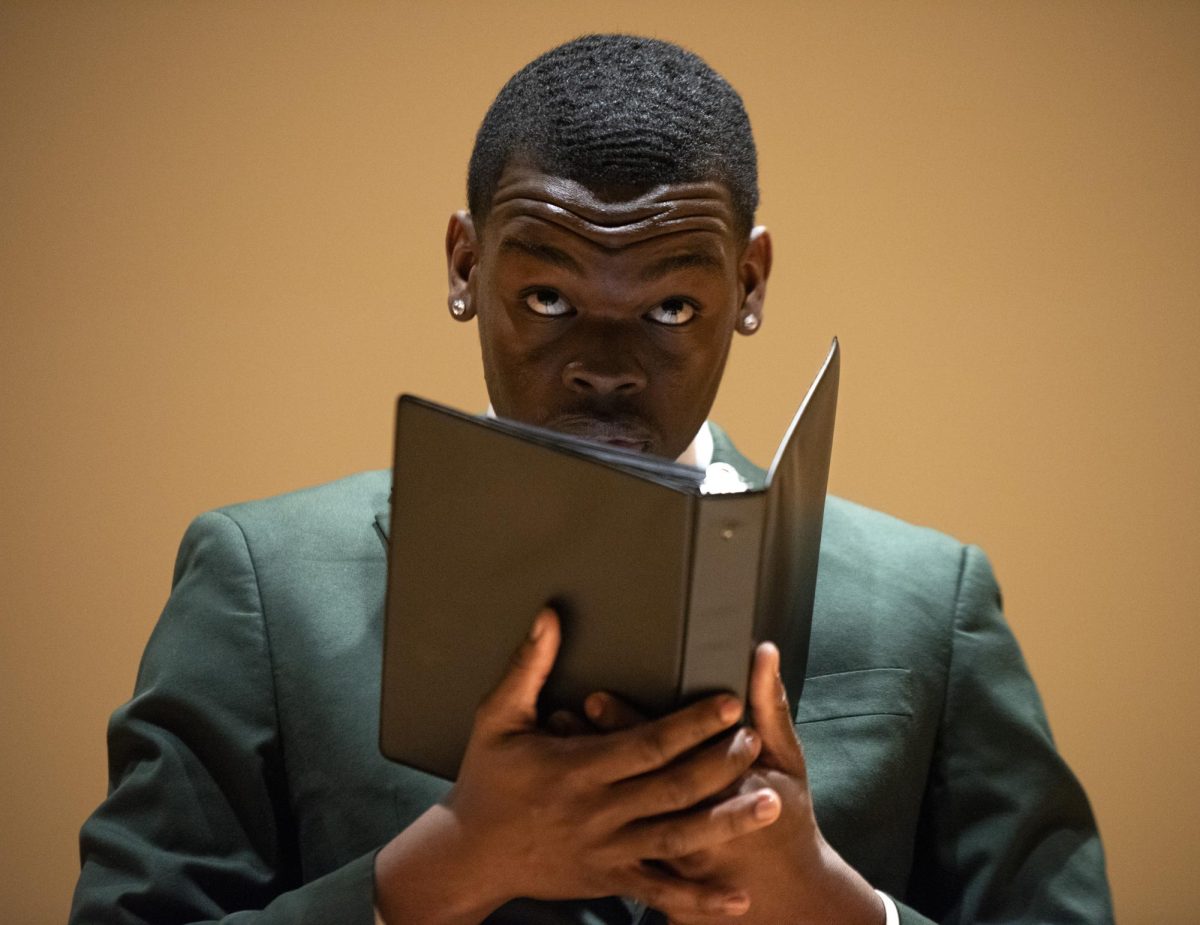
Three students performed their interpretation events for the crowd. Interpretation is “an academic spin on acting,” Johnson said. Interpretation pieces are also 10 minutes long and memorized, but are written by published authors, not the students themselves, and require speakers to carry the script on them, usually in a black binder.
Interpretive events include prose, poetry, dramatic duo, single dramatic interpretation and declamation.
Elizabeth Allen, a sophomore majoring in professional legal studies and physics, interpreted “Do We Know How to Grieve” by Francine Wheeler, a mother whose son, Benjamin, was killed in the 2012 Sandy Hook Elementary School shooting. In the text, Wheeler struggles with the “destabilizing effects of trauma on cognition,” Allen said.
“Today, many Sandy Hook parents struggle to recall details now mired in public contestation,” Allen said in her introduction of the piece. “Author Francine Wheeler uses storytelling to repair her own memory.”
Allen broke out of the preliminary rounds to the finals rounds both days of the UA Alumni tournament and won second place twice.
Ismail and Aquilla Dunn, a sophomore computer science major, performed as a duo in the second interpretive event and last performance of the night.
Dunn and Ismail combined the TV show “Beyond Scared Straight,” the poem “Would You” and the drama “Protected Custody” to create a program about incarcerated transgender people and the erasure of their identities.
“Prison is the only institution where misgendering is built into the architecture,” Dunn said.
In the duo event, competitors performing together are not allowed to make eye contact or physical contact. Ismail and Dunn worked around the rule by facing the audience as their characters talk to each other.
The pair began work on their performance in June.
“All of the performers spend long, long nights practicing and long, long weekends competing,” Reck said.
Their dramatic duo performance won the UA Alumni swing and contributed to Jade achieving the Holle Award for Excellence in Forensic Competition, a recognition for the most points across both days of the tournament.
Reck and Johnson introduced Ameya Puranik, a senior chemistry major, to demonstrate a shortened excerpt of a Lincoln-Douglas debate event.
Johnson said competitors research both sides of a topic “so they can fight against each other on it, forming arguments.” Debaters present either the affirmative or negative side, and may compete alone or in teams of two.
“The one v. one is called LD, while the two v. two is called policy,” Johnson said.
Puranik spoke at a rapid pace about the United States’ activity in the polar ice regions. He delivered key elements of his argument clearly and loudly, while the majority of his speech was too fast to comprehend.
“Debate speeches have a time limit, not a word limit, which means that it is strategically viable to speak incredibly fast to try to cram in as many arguments as possible,” Reck said.
The audience followed an online document of Puranik’s argument while he spoke.
“Ameya is using citations from over 25 different sources,” Reck said. “Around what might be expected from an undergraduate research paper.”
After Puranik’s affirmative argument, Reck questioned his stance through a process called cross examination, which is usually done by the opposition. Since Puranik gave both the affirmative and negative arguments, Reck stepped in.
In LD, Puranik advanced to the first round of finals, called octofinals, at the Washburn University tournament and the quarterfinals round at the University of North Texas tournament.
Each speaker received applause for their performance. Audience members were not shy about reacting during speeches either, with hums and nods of approval and sniffles during emotional moments.
“On behalf of the entire WKU forensics program, we thank you so, so much for spending your evening with us,” Reck said, closing out the showcase.