WKU lost to Middle Tennessee State University in the annual 100 Miles of Hope Blood Drive Competition, sponsored by the American Red Cross.
WKU announced on Friday, Nov. 14, at the WKU vs. MTSU Football game that MTSU won the 100 Miles of Hope Blood Drive competition by 77 units of blood.
The universities collected blood from Monday, Oct. 20, through Wednesday, Oct. 22, said Grace Lartey, WKU public health professor. Lartey said WKU collected 259 units of blood, and MTSU collected 336 units.
Lartey, a blood drive organizer since 2021, said this annual challenge has helped WKU and MTSU become the largest contributors to the Tennessee Valley Region Blood Bank. She said the blood drive has been going on since at least 2010, and MTSU also won the challenge last year.
Lartey said there is a lot of planning involved in the blood drive.
The dates and times of the blood drive have to be the same at both universities. She said they also have to consider the universities’ academic and athletic calendars to line up a week that works for everyone.
Lartey said participation in the blood drive “has not been that good” this year at WKU. She said this could be from some of the changes made over the year to the blood drive.
For example, Lartey said people could only participate in the drive from 12 p.m. to 6 p.m. over the course of three days this year. Students last year could participate between 10 a.m. to 6 p.m., giving them two extra hours in the day.
Lartey also said they wanted to do the drive in November, but with WKU’s Homecoming Parade being on Halloween weekend, the universities decided to do it earlier. She said the competition is done every year to give back to the community and keep blood banks stocked.
“It goes a long way to know that we are able to support the community between Kentucky and Tennessee,” Lartey said.
Chris Massaro, MTSU Athletic Director, thought of the idea for the 100 Miles of Hope Blood Drive in 2010.
Massaro said he came to MTSU from the University of South Carolina. He said the idea for the 100 Miles of Hope Blood Drive derived from a state “rival blood drive” between USC and Clemson University.
“It was the rival blood drive,” Massaro said. “And as luck would have it, this was quite a coincidence, the first few years that they did it, whoever won the blood drive won the game.”
Massaro said people from both universities started to give blood so their team would win the game. He said the numbers “went off the charts.”
Massaro said he didn’t think of the name for the blood drive, but he said it’s based on the 100 miles of distance between WKU and MTSU.
“You never know when people are going to need blood, whether it’s a birth of a baby, whether it’s a car accident, whether it’s somebody fighting a disease,” Massaro said. “Most of us are going to be touched by it somewhere, somehow, with a blood donation. It’s kind of paying it forward, so to speak, helping people out, and saving lives and keeping families together.”
Massaro said this drive has “really worked well” between WKU and MTSU and highlights the universities’ rivalry. He said the blood drive gets most schools to work together for a common cause through competition.
Participants who gave blood received a free shirt. Free juice and snacks were also available to participants.
Student organizations also had a chance to participate in the 100 Miles of Hope Student Spirit Challenge, where student groups could win a WKU prize pack if they had the most blood donations, according to WKU’s Blood Drive homepage.
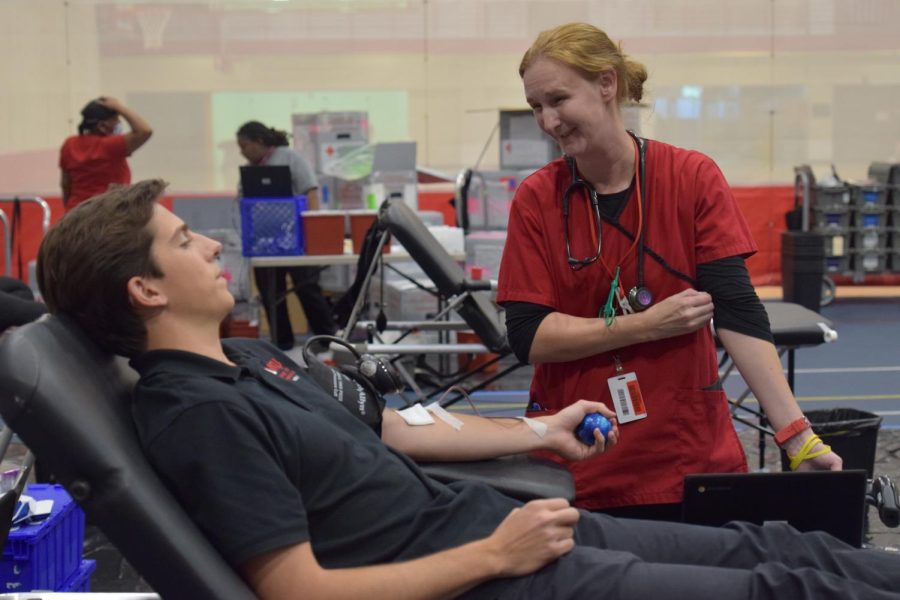
Matt Federico, a sophomore nursing major, gave a Power Red blood donation at the event.
A Power Red blood requires a special machine to allow donors to safely donate nearly double the amount of their red blood cells to make “twice the impact” compared to a regular blood donation, according to the American Red Cross’ website.
Two units of red blood cells are taken at once during a Power Red blood donation, and the website stated that the donor’s plasma and platelets are returned in the process.
Federico said that as a nursing major, he has a duty to help other people.
“Nurses always put patients first, and giving blood to patients in need is putting them first,” Federico said.
B Watson, a senior public health major, volunteered at the blood drive for her first time on Wednesday. Watson was one of multiple student volunteers who helped out with the blood drive.
Watson said she doesn’t meet the qualifications to give blood, so she volunteered at the check-in table during the blood drive.
“People like me who can’t donate blood, we can donate our time to help out these causes,” Watson said.