WKU’s state performance funding has decreased for the fourth year in a row, dropping from $5.3 million in 2025-26 to $4.4 million for the 2026-2027 year.
WKU blames the drop on a performance funding model that it says favors Kentucky’s two R1 institutions, University of Kentucky and the University of Louisville.
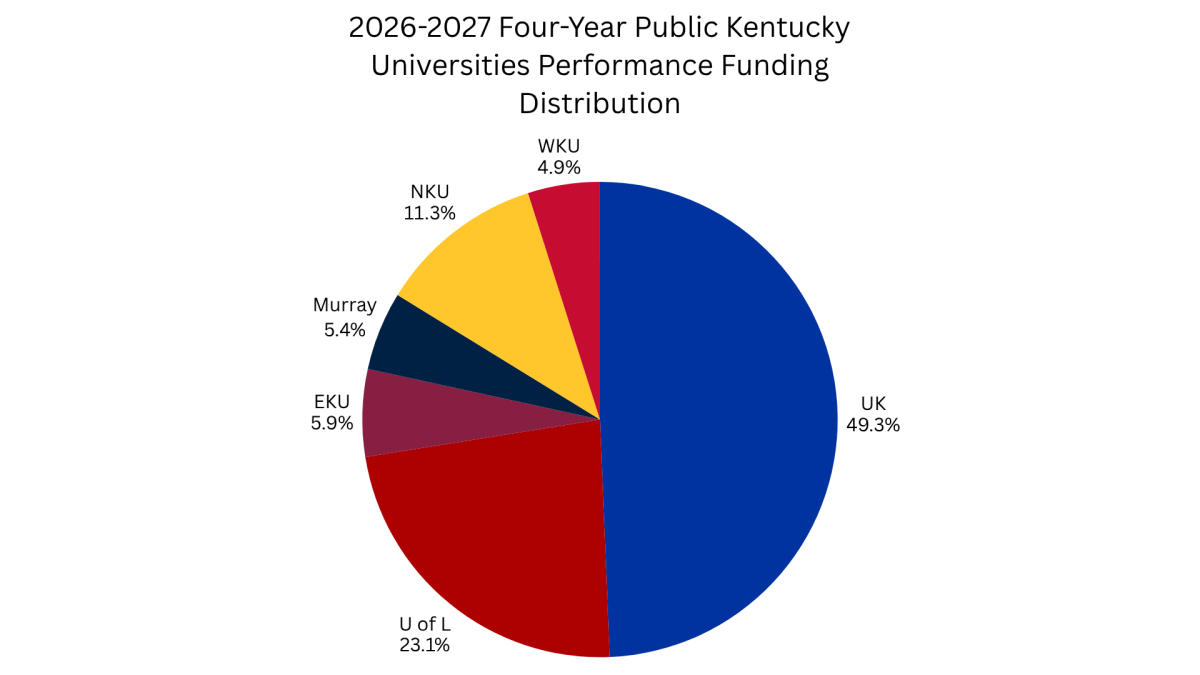
WKU received only 4.9% of the $89.7 million performance funding budget allocated by the state for its eight public four-year institutions, the smallest amount of funding distributed other than zero dollars to Kentucky State University and Morehead State University.
University of Kentucky and Eastern Kentucky University were the only two that saw increases in their budget, with UK’s jumping over $3 million to $44.2 million and EKU’s increasing from $4.9 million to $5.3 million. Every other performance funding allocation received decreases of around or over $1 million.
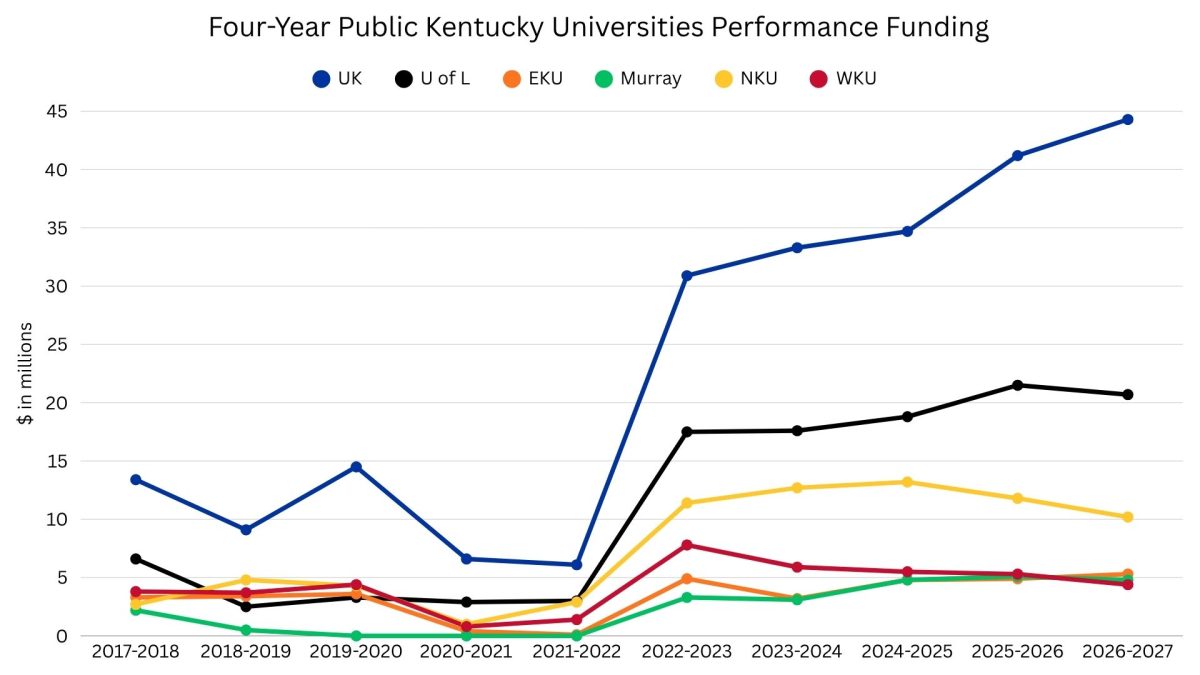
With the passage of Senate Bill 153 in 2017, the Council on Postsecondary Education implemented new funding models for public Kentucky universities and the Kentucky Community and Technical College System that would align a portion of state funding with university performance and student success.
“One of the things that I think is important for the Commonwealth of Kentucky is that we actually do hold ourselves accountable as institutions for the funding we receive, and that we are pursuing goals that are important to the Commonwealth,” WKU President Timothy Caboni said following the June 5 Board of Regents meeting.
The performance funding models require institutions to compete with each other for a designated amount of state money outside of funds for mandated programs and bond debt services. Based on three-year averages of university outcomes, this competition aims to financially incentivize universities to push for student retention, progress and success, moving towards state goals for postsecondary education.
The models were developed and recommended by a Postsecondary Education Working Group, which was chaired by former WKU President Gary Ransdell.
For four-year universities, funding under the models are divided and determined by three metrics:
- 35% of funding is based on student success outcomes.
- 35% on the institutional share of credit hours earned across public Kentucky universities.
- 30% on the university’s share of operational needs.
However, the state’s two R1 research institutions, a multiplier of around 1.5 is applied to their statistics. While a comprehensive institution and an R1 institution could have the same number of degrees conferred, an R1 institution would be credited with 1.5 times the number of degrees.
While WKU enrollment has been trending downward, going to its lowest since 2000 in Fall 2025 with 15,920 students, university success metrics are competing with those of R1 institutions.
According to the CPE’s database, WKU’s retention rate of 79.4% ranked as the third-highest among four-year public Kentucky universities from Fall 2024 to Fall 2025, falling behind UK with 85.3% and U of L with 84.1%. It also awarded the second largest number of undergraduate degrees in 2025 with 3,624 degrees, trailing behind only UK’s 5,671.
WKU has seen a record overall graduation rate of 59.1%, competing for the third highest in the state with U of L’s 59.6% alongside UK’s 71.1% and Murray State University’s 62.2%. WKU’s four-year graduation rate sits at 41.7%, higher than U of L’s 40.8%.
“The model is primarily based on volume and not necessarily on performance,” said University Spokesperson Jace Lux. “While WKU’s retention rate and graduation rate have increased during this time, WKU’s headcount has declined over the same period, resulting in reduced performance funding.”
During the June 5 Board of Regents meeting, Caboni said the Kentucky legislature has appointed a performance funding review committee to review and revise the funding model. The committee will have its first meeting on June 25, according to the CPE.
“All of a sudden, we are taking a reduction on that metric because we didn’t meet the performance of the two research universities,” Caboni said. “It’s not sustainable over time, and we must address that as a group of presidents and legislators…”