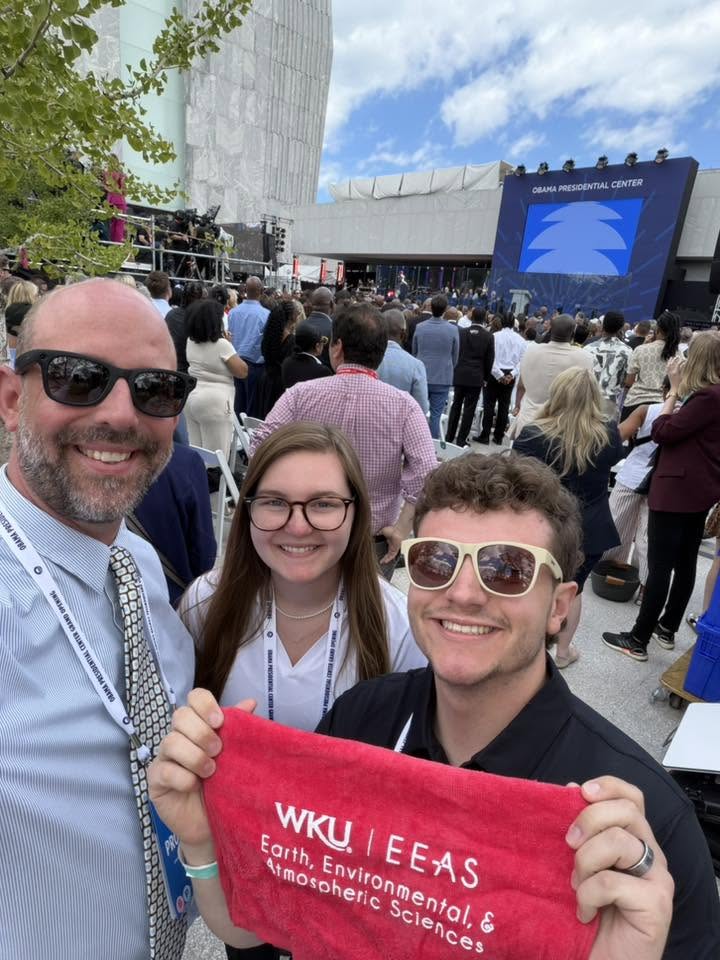
Among the stars and politicians present at the Obama Presidential Ceremony was WKU meteorology professor Josh Durkee, along with his two Homeland Security Science master’s students Harmony Guercio and Thomas Payette.
While some present spent their June 18 at the newly opened Obama Presidential Center walking around the grounds or previewing the museum, Durkee and his team were there with equipment in hand to provide a hyper-local forecast. A weather support service pioneered by WKU Meteorology, their meteorological observations were used to inform the behind-the-scenes decisions regarding the logistics of the ceremony.
To Durkee, the way that WKU became involved in the event “is a little bit of a mystery”. He theorizes that a colleague at the Chicago Marathon, another organization WKU has provided event-specific meteorology for, could have referred them.
In April, Durkee and his students sent off a proposal detailing weather support logistics. According to Durkee, the Center liked what they saw, aware of WKU’s history and familiarity with hyper-local forecasting in the area.
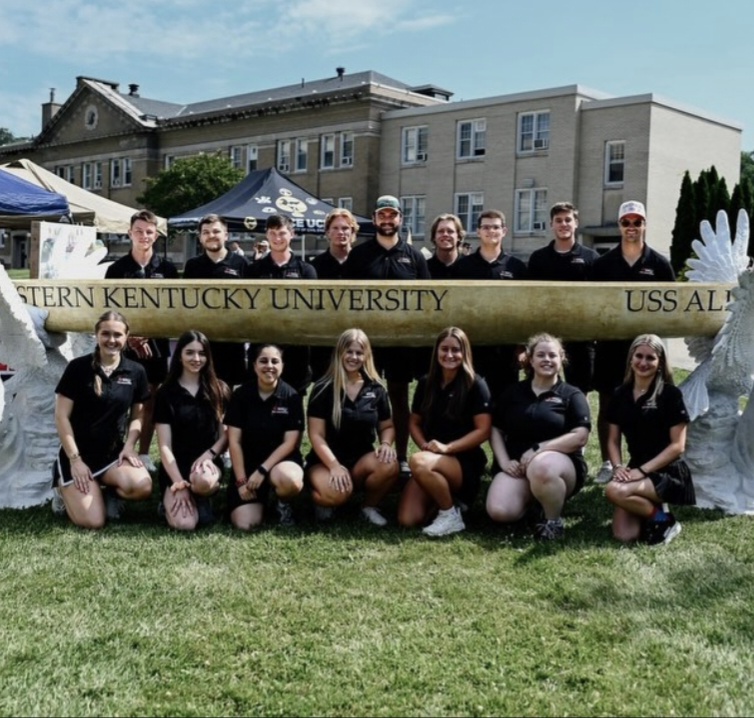
WKU has been leading the country in hyper-local forecasting services, providing forecasts specific to an event’s date and location for various organizations and events.
For the chair of the Department of Earth, Environmental, and Atmospheric Sciences, Leslie North, the recognition of the “Crown Jewel” meteorology program through the ceremony is an incredible honor.
“We’re not just applying weather information in the traditional ways that it has been applied,” North said. “They really have worked hard to create tools, to create methods to innovate and communicate the importance of the work that they do, and why you need their support in these types of events.”
Using a method developed for the Special Olympics USA Games in 2022, WKU meteorologists can get a more accurate meteorological reading that can inform decision-makers on event specifics dependent on the weather. The meteorology program has been able to expand its specialty’s framework through the White Squirrel Weather service, applying it for WKU and across the country.
“I know some people are like, the weather doesn’t really matter that much, but it does matter a lot,” Guerico said. “Even for indoor events, you would think whatever the weather is going to do isn’t going to matter, but for logistics, for parking, for traveling, that’s going to matter.”
Weather concerns for the ceremony surrounded heat stress for its well-dressed participants amplified by the Center’s stone surfaces, as well as strong winds and rain that preceded the big day.
“Everyone’s rushing to get things done in a timely manner, so we had concerns over slips and falls, even simple things like getting everything dirty,” Durkee said. “(We got) down to just the little bits and pieces of the details of the event.”
Weather support for the event began over two months in advance, with an analytical review of the event’s weather scope and developed expectations crafting the cohesive weather plan with “what if scenarios,” Closer and closer to the event, the team begins a forecast discussion with information refined at higher resolutions.
The Saturday before the ceremony, the team arrived in Chicago for on-site measurements. From Sunday till Thursday, they provided weather briefings and answered questions about event logistics.
Originally, only Durkee had been contacted for weather support. However, he specifically requested that his graduate students join him and give them the unique opportunity.
“For me, the whole point and purpose of this thing that we do is to train our students and get them prepared for a professional career, and we do that in a way that is unmatched by other universities right now,” Durkee said.
While in Chicago, Guerico and Payette didn’t just help maintain the weather equipment and collect information. When Durkee had to step away for private forecast discussions, the students manned the weather desk, where crew or staff could walk by at any moment with questions.
Although Payette described the experience as a “pressure cooker moment”, he felt like it was validated by decision makers when he was able to provide information and input.
“Dr. Durkee has the PhD and everything, but there’s enough trust in him and enough trust in the grad students that (people) were comfortable coming to us and saying, is it going to rain in the next five minutes, what are the winds doing?” Payette said.
Guerico said helping directly influence decisions was stressful, but gave her confidence in her degree and knowledge level. It also made her feel important, being asked questions and thanked by high-profile public figures.
Though the team had expected attention from the event staff, they were all surprised by the amount of attention put on their job. Typically, like the weather, the work of meteorologists is often a second thought at events unless something goes wrong.
“But at this event, every single person who walked past us would be like, oh my gosh, it’s the weather guys,” Guerico said. “It was just kind of crazy how everyone seemed so shocked at what we were doing, because usually we don’t get too much recognition for it.”
In the midst of their work, Durkee, Guerico and Payette received thanks from staffers and celebrity ceremony attendees alike. As “the cherry on top of all that validation,” according to Durkee, the team was able to shake hands with former President Barack Obama and was praised for their good work.
“I think that’s really sort of the end game for a lot of meteorologists,” Durkee said. “We love weather, we love the science of weather, we love experiencing the weather, but we also love using that passion and that knowledge to help people.”