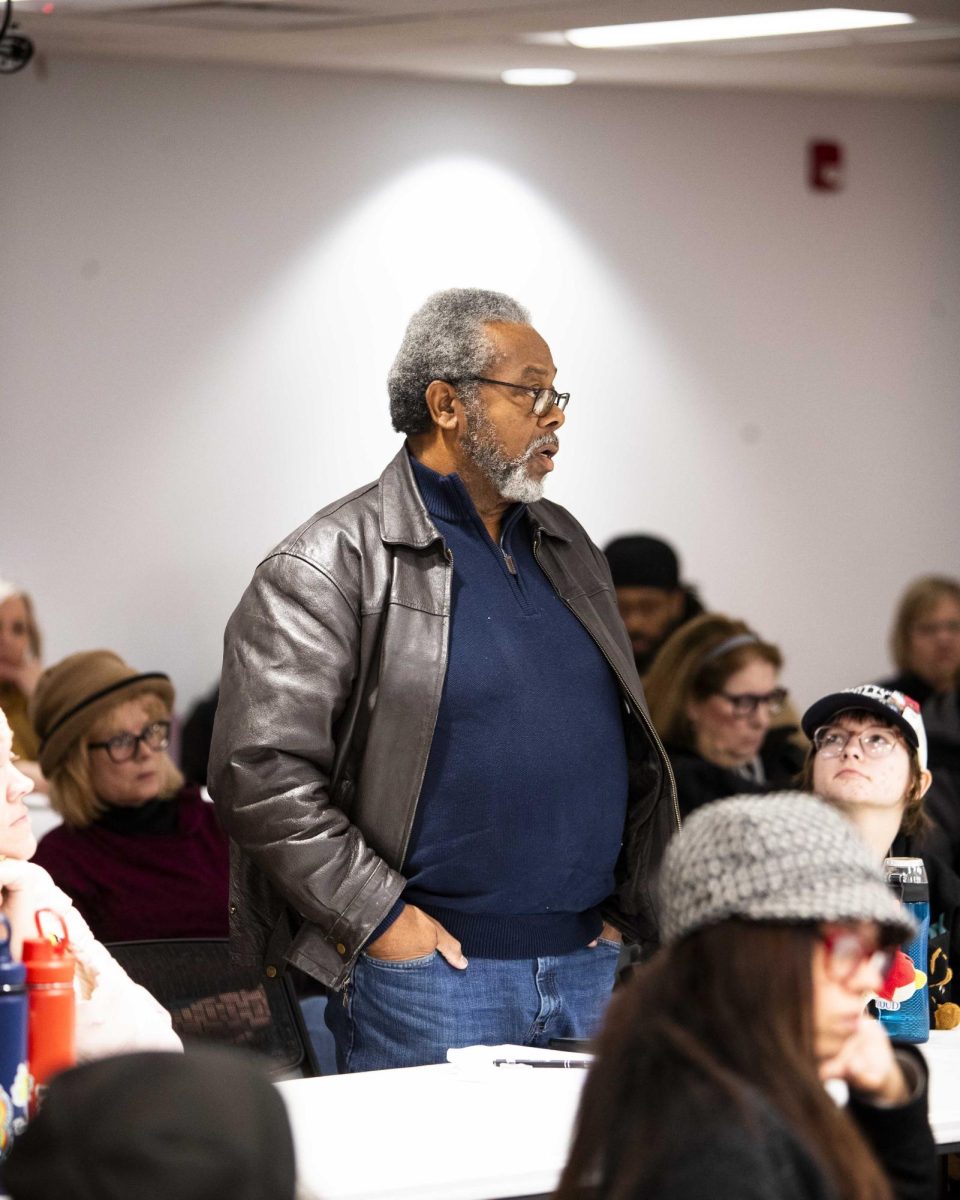
More than 60 people filled the meeting room in the front of Lisa Rice Library Saturday afternoon to get involved with a local organization aimed at building community and protecting immigrants.
The organization, Bowling Green Community Defense, aims to provide on-the-ground support to individuals and families whose legal status could make them a potential target for Immigration and Customs Enforcement.
“This work is about harm reduction and solidarity across the board, preparation allows us to respond calmly, legally and effectively,” organizer Ayla Newton said. “ICE activity impacts our entire community. Solidarity is protection. Rapid Response saves time, safety and lives.”

Al Sack, one of the founders of Bowling Green Community Defense, said that there have been around a dozen people working to bring the group together since June.
“They (ICE) have been operating relatively quietly,” Sack said. “It’s not, obviously, like what we’re seeing in these larger cities where these big operations are happening, but we’ve heard chatter now for a while that they will be here in a larger operation.”
Newton said tips of ICE activity possibly spiking in the near future is a “huge incentive for (the organization) to get together and form rapid response teams.”
There is an unmarked Department of Homeland Security office at 1013 Morgantown Road that has become a frequent site for demonstrations.
The sprawl of operations from ICE, Customs and Border Patrol, and other related agencies over the first year of the second Trump administration has raised concerns for many. The recent deployment of more than 3,000 federal agents into Minneapolis and the Twin Cities metro area has prompted public outcry and legal action.
The shootings of Renee Good and Alex Pretti by ICE and Customs and Border Patrol agents have raised concerns for many about protocol and procedure, as well as how to maneuver through interactions with federal immigration authorities.


“What happened to Alex Pretti can happen to anybody,” Newton said. “When Renee (Good) passed, a lot of us came together in a group call and just mourned, because that could have been anybody in any situation anywhere.”
Pretti and Good were both acting as constitutional observers, who work with the Rapid Response teams and document interactions with federal agents. If an individual is being detained, observers will try to get information like a name, date of birth and an emergency contact to make it easier for family to find them.
The ongoing DHS operation in Minnesota, titled Operation Metro Surge, began in early December 2025 with a focus on the state’s large Somali population. A federal fraud case in Minnesota with a majority of Somali defendants sparked discussion, including President Trump referring to Somalis as “garbage,” and that he wanted them sent “back where they came from.”

Bowling Green has a large immigrant community, including the largest Somali population in Kentucky, according to data analysis firm Neilsberg. Newton said that there are at least 2,000 immigrants in Bowling Green of high concern for DHS targeting. Speakers emphasized that everyone in Bowling Green, regardless of immigration status, belongs.
“We consider all of us Bowling Green. These are our streets, and these are our people,” media liaison Wyatt Southerland said. “Whether you’re a citizen, a permanent resident, an asylum seeker, an international student… this is your community.”
Bowling Green Community Defense has broken responsibilities up into teams.
When ICE activity is reported, the Rapid Response team is tasked with quickly responding to ICE sightings, supporting impacted individuals and families, coordinating with constitutional observers and providing first aid and medical support if needed. These responders are required to have first aid and CPR training as well as civic and de-escalation training. These responders also warn others in the area of ICE’s presence with whistles and car horns.
“I can’t speak for everyone’s motivation, but for me, personally, I have a serious problem with people just being disappeared,” said organizer Macy Williams. “What you do as an observer is you show up, and they don’t disappear.”
The group also accompanies people to legal hearings and immigration check-ins at the federal courthouse or ICE field office in Louisville.
“It’s going with them to provide security and comfort,” said Cathy Severns, a founding member of local advocacy group SOKY Indivisible. “The courage they have is beyond our comprehension.”

The group said they are in search of lawyers and others with legal knowledge and experience, as well as translators.
The Mutual Aid and Recruitment team is tasked with the distribution of things like ICE hotline cards and “Know Your Rights” cards, as well as food, clothing and supplies for those who need them.
The Hotline and Backend Support team is tasked with verifying claims of ICE activity and alerting Rapid Response and Legal Observers, who can then be dispatched to the scene. They also help coordinate less urgent needs, like legal accompaniment, answering questions, and providing education and emotional support when needed.
Speakers encouraged members of the audience to contact elected officials and representatives with their concerns about ICE and immigration enforcement. In particular, Kentucky Senate Bill 86 would require all state and local law enforcement to work with ICE and participate in immigration enforcement. The Bowling Green Police Department and the Warren County Sheriff’s Department have no formal agreement with ICE.