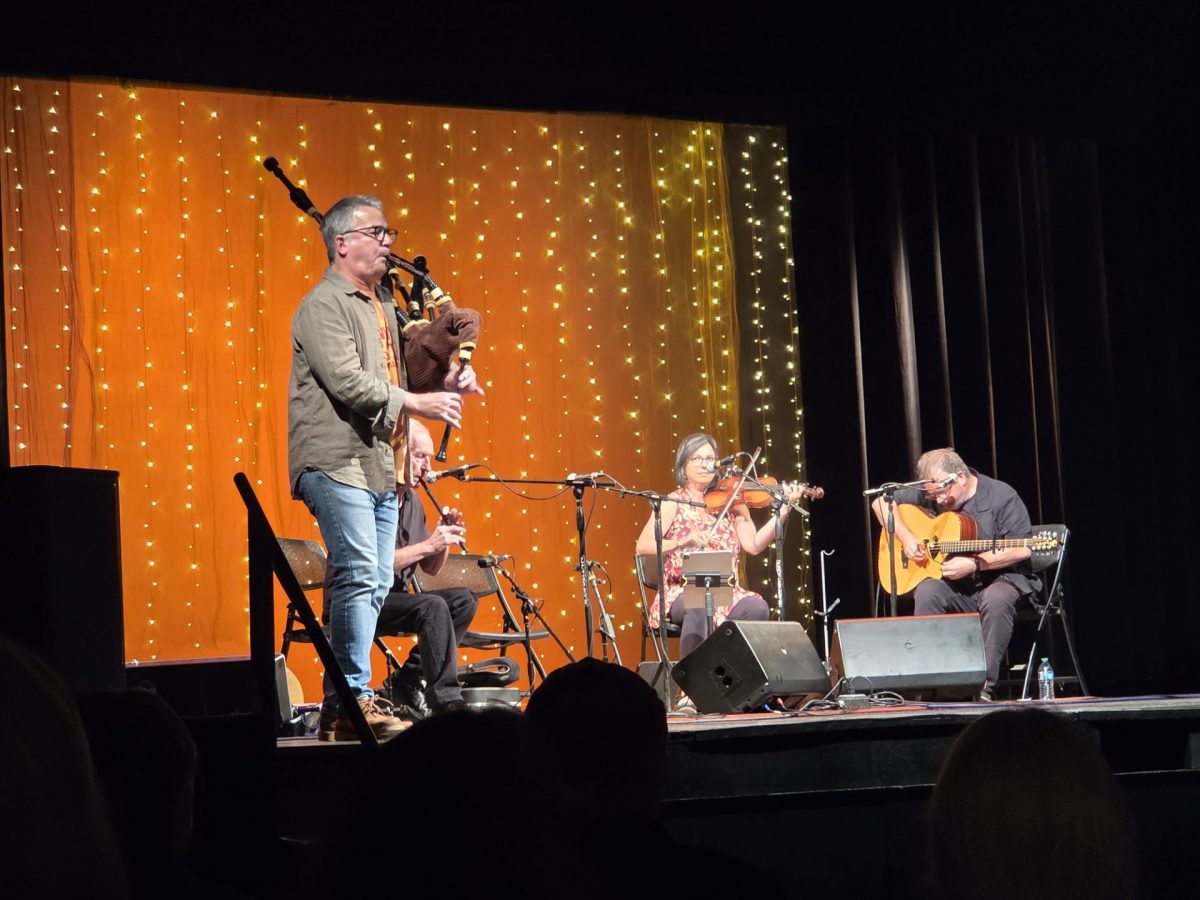
Shrouded by warm oranges and purple lights, the Capitol’s annual Summer Solstice Concert brought the Celtic nations to Bowling Green through a night showcasing the musical stylings of four Celtic musicians.
Since 2018, the Capitol has collaborated with husband-and-wife Celtic musicians Rebecca Baumbach and Skip Cleavinger to host semiannual concerts for the summer and winter solstices. Alongside Irish dancers, the musicians took time to explain the history and culture behind the performance while discussing their efforts to bring Celtic music to Southern Kentucky.
Baumbach and Cleavinger were joined on stage by fellow musicians Pat Broaders and John Skelton. Broaders, a five-year summer solstice veteran, played a guitar-like instrument called the bouzouki while Skelton showed off his knowledge of various traditional pipes and whistles for the eighth year in a row.
The solstice concerts have become a part of the duo’s family traditions, serving as a way to celebrate the community, history and abundance that the solstice represents.
“There’s so many people here that celebrate in other ways, and so from the very start, we wanted to amplify that story, amplify other traditions, other ways of thinking about the solstice, other ways of worship,” Cleavinger said.

During the hour-and-a-half-long performance, the musicians played music from various Celtic nations while sharing information about the songs and instruments presented. Educating and connecting the packed audience with the culture behind the traditional songs was important for the musicians.
“They’re not just tunes, it’s not just the notes on the page,” fiddle player Baumbach said. “It’s about the people who have played them, the counties that they were played in, and how it traveled from one place to the next.”
The musicians also tried to send a message of immigration and resettlement that resonates with Bowling Green’s overall diverse community, a common theme amongst many of the songs and stories shared.
“That’s an Irish story, it’s a Scottish story, it’s an American story, and it’s a really big story here in Bowling Green,” Cleavinger said.
Though originally said during the performance as a joke, Cleavinger, who played a variety of traditional Celtic wind instruments, wanted it to feel like everyone was in a big living room together, enjoying the music. They invited people to clap and sing along with them during various songs, cracking jokes and asking questions to the audience afterwards.
“It is a special thing to be in somebody’s home and just have that intimate connection, musically to be able to play with friends and family, and we just really wanted to include other people in that,” Cleavinger said.
Throughout the night, the musicians were joined on stage by four Irish dancers from the Scott-Ellis School of Irish Dance based in central Tennessee. This was the second time the dancers were involved in the celebration, performing traditional dances to the music.

Growing up in the scene, Bayleigh Kilpatrick felt like the solstice experience had been able to take Irish dancing back to tradition. As an Irish-American, the way she celebrates comes from her Irish roots, dancing and having fun during momentous occasions or rebellions.
“Ireland in general has a really rich cultural history with music and dance and how it plays into them as a nation now and what they’re still going through, so the fact that we can use this to further do that, but do it through an artistic lens is really awesome,” Kilpatrick said.
Towards the end, Baumbach and Cleavinger shared about SKy Celtic Arts, their newest initiative to grow Celtic music in the area.
“It just occurred to us that over eight years, close to 1000 people a year come out to hear the music, and so obviously they’re people who really enjoy this music, so why not start teaching people?” Baumbach said.
SKy Celtic Arts offers classes for tin whistle, pipes, bagpipes, and other instruments, as well as Irish and Scottish repertoire classes for those familiar with instruments. Since the Irish and Scottish had a hand in growing the Southern Kentucky community, the classes aim to amplify the story and traditions of them in the area.
For Cleavinger, it is rewarding to come together with the audience, especially in a “divisive” and “dividing” time.
“The fact that people come together, get a babysitter or go to dinner, and then come over here and just take the time to come out,” Cleavinger said. “It’s a human connection that goes deeper than the music, deeper than the cultures.”