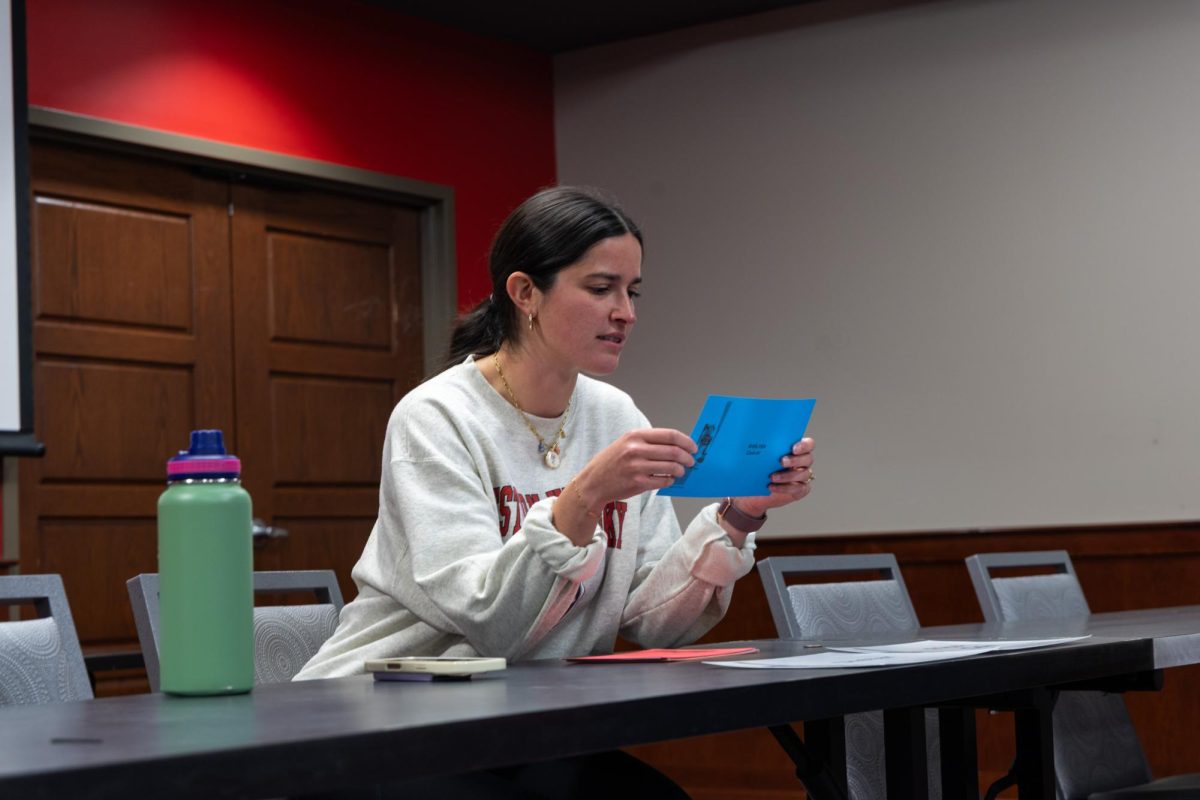
Students got to understand the experience of seeking help as a domestic and dating violence victim, taking on scenarios of the hardship at “In Their Shoes.”
Melanie Evans, WKU coordinator for sexual assault services, brought “In Their Shoes,” a community education tool about domestic violence, to WKU on Wednesday to inform students of the complexities of domestic and dating violence, and what people can do to seek or provide help. October is domestic and dating violence awareness month, bringing notice to survivors and how to seek help.
“We conduct this event during domestic and dating violence awareness month because it gives students an understanding of the different types of challenges that survivors of domestic and dating violence experience,” Evans said.
“In Their Shoes” is a “choose your own adventure” experience, Evans said, that takes participants through various domestic and dating violence scenarios. The scenarios are meant to highlight the intricate nature of receiving help in dangerous situations. Students started by reading a card that depicted a person’s backstory and relationship.
A card was then handed out detailing the abuse that unfolds. Multiple paths were then revealed for what the next steps are. Steps could have been seeking help from friends or family, seeking a clergyman or any of the other 15 stations that were situated across the tables.
Seeking help from friends or family brought about multiple outcomes depending on the scenario. Sometimes it worked out well, with the person finding a safer situation. Other times it led to dismissal from family members and no answers for the scenario’s victim. In one case, the victim ultimately went back to their abuser — bringing a harrowing reality to the experience.
“I just feel like there’s a lot of things that don’t get talked about, as far as being put in the position of who to go to for help — why to go get help,” said Tyreesha Morns, a sophomore business management major.
Karen Witzel, a victim advocate at Hope Harbor, volunteered at the event. She said that overcoming domestic violence starts with prevention — educating people, setting good boundaries, learning good coping skills and building healthy relationships.
“That’s what this event here did,” Witzel said. “It really drew attention to how actually complicated it is.”
She said she was “pleasantly surprised” by the structure of the event, having never seen anything like it before.
“It really drew attention to how complicated it is,” Witzel said. “It’s not a simple Google search.”
The event ended with a discussion amongst participants about what they experienced. Participants discussed roles as bystanders and further dismantled the misconception that seeking help for domestic violence victims is black and white.
Evans also pointed to the various resources on campus. The WKU Counseling Center stands as a confidential way for students to seek support. The faculty and staff can also offer their help, although without confidentiality. Evans emphasised that while faculty and staff are mandatory reporters, they are solely there to get the information to people who can help.
Hope Harbor acts as an off-campus resource for domestic and dating violence. It offers recovery services for sexual trauma survivors with special treatment intervention, a 24/7 hotline, counseling, legal accompaniment and legal advocacy.
“It (domestic violence) doesn’t discriminate,” Evans said.