Editor’s note: This story has been updated with the correct name and title of Andrew Mienaltowski and Mac McKerral’s full title.
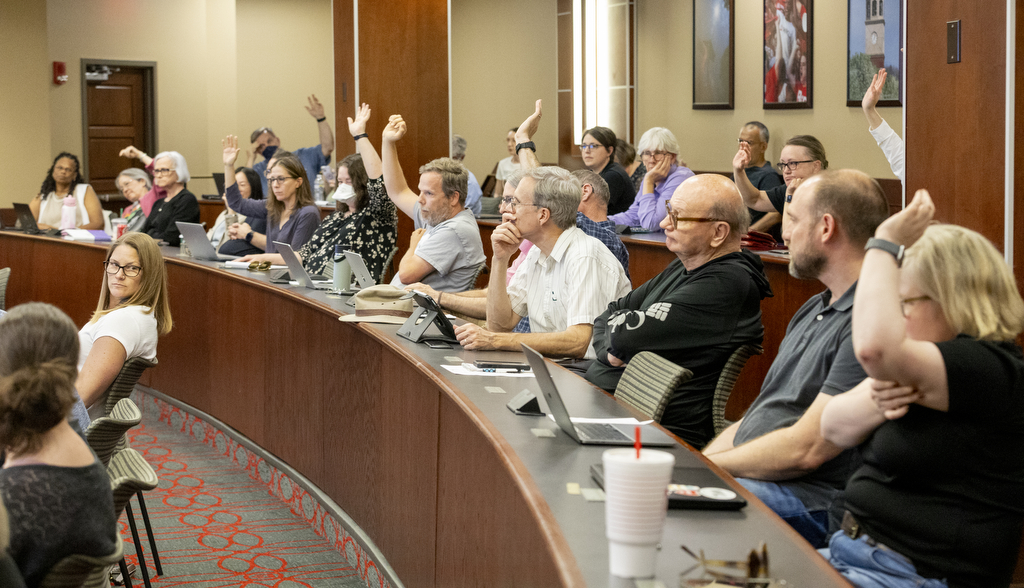
WKU Faculty Senate discussed the Kentucky Legislature’s budget decisions, proposed senate charter changes and elected their 2026 – 2027 senate officers at its meeting Thursday.
The Kentucky Legislative session ended yesterday, which finalized the budget for Kentucky universities’ revenue. Kurt Neely, at-large senator, announced amendments to House Bill 197 that restored Kentucky universities’ base budget funding to a flat rate. As of Tuesday, House Bill 500 listed a 4% funding reduction across Kentucky postsecondary education, Assistant Vice President of Government & External Relations Jennifer Smith said in an email.
The Kentucky Legislature also passed House Bill 490 Tuesday, which allows universities to remove faculty, including those with tenure, for financial reasons. Provost Bud Fischer reassured faculty concerned about the bill.
Faculty Regent Shane Spiller said he and Fischer scheduled a meeting with WKU General Counsel Andrea Anderson to get her perspective on potential changes to the Faculty Handbook to stay in compliance with House Bill 490.
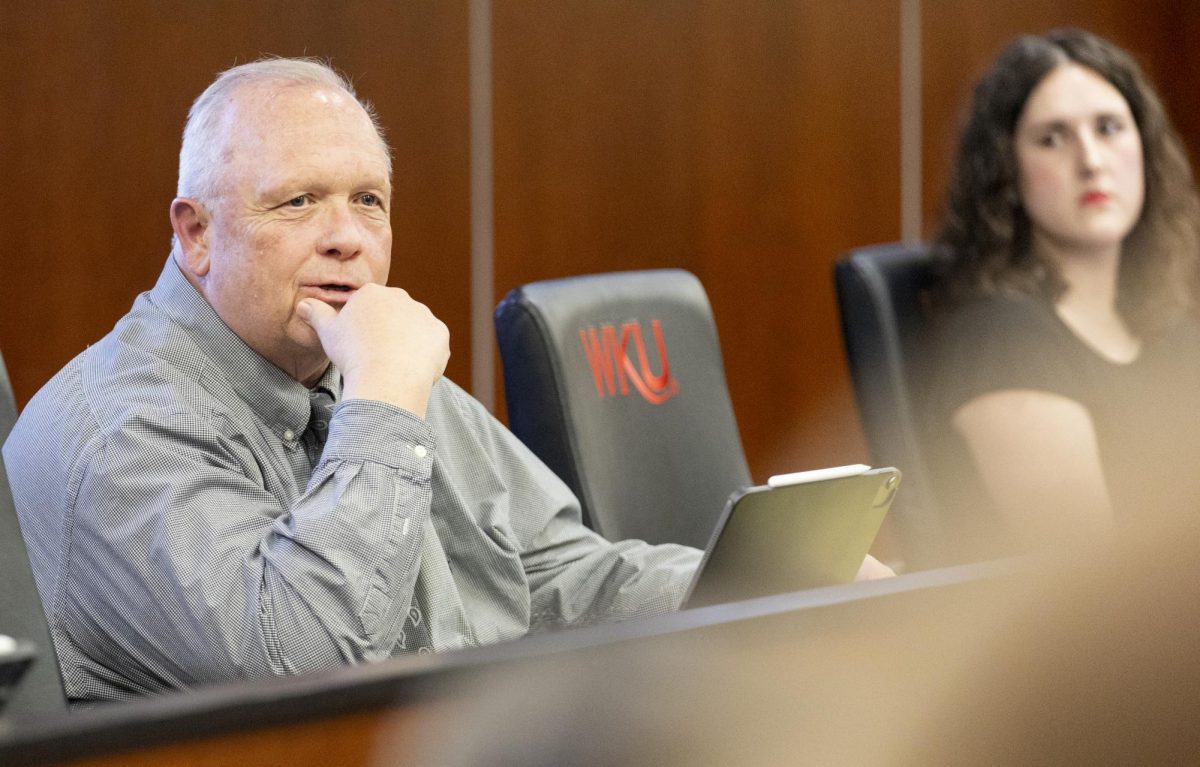
Fischer said he expects to make few changes to the handbook, and that they’d work out changes over summer break.
“Take a deep breath,” Fischer said.
Fischer recapped the Student Scholar Showcase, where two WKU Goldwater scholars presented their work in Downing Student Union on Saturday.
The Goldwater scholarship is a nationally offered scholarship for the “next generation of researchers in science, engineering, and mathematics,” according to the scholarship website. Fischer said only four Kentucky college students received the scholarship.
Spiller also discussed the public-private partnership deal between WKU and Gilbane. Spiller said the deal is not yet fully approved, and that the Board of Regents is working with advisors to ensure the 500-page deal is “good for WKU.” He said the deal will not add to WKU’s debt.
Spiller described WKU’s housing as a “hindrance” to the student experience and enrollment. He said aspects of the student experience, such as connections with faculty, fun activities, and sports games, do not matter if a student’s dorm is a place they never want to be.

SGA Student Body President Rush Robinson, who sat next to Spiller, agreed and told senators to “take a field trip” to see the state of WKU’s dorms.
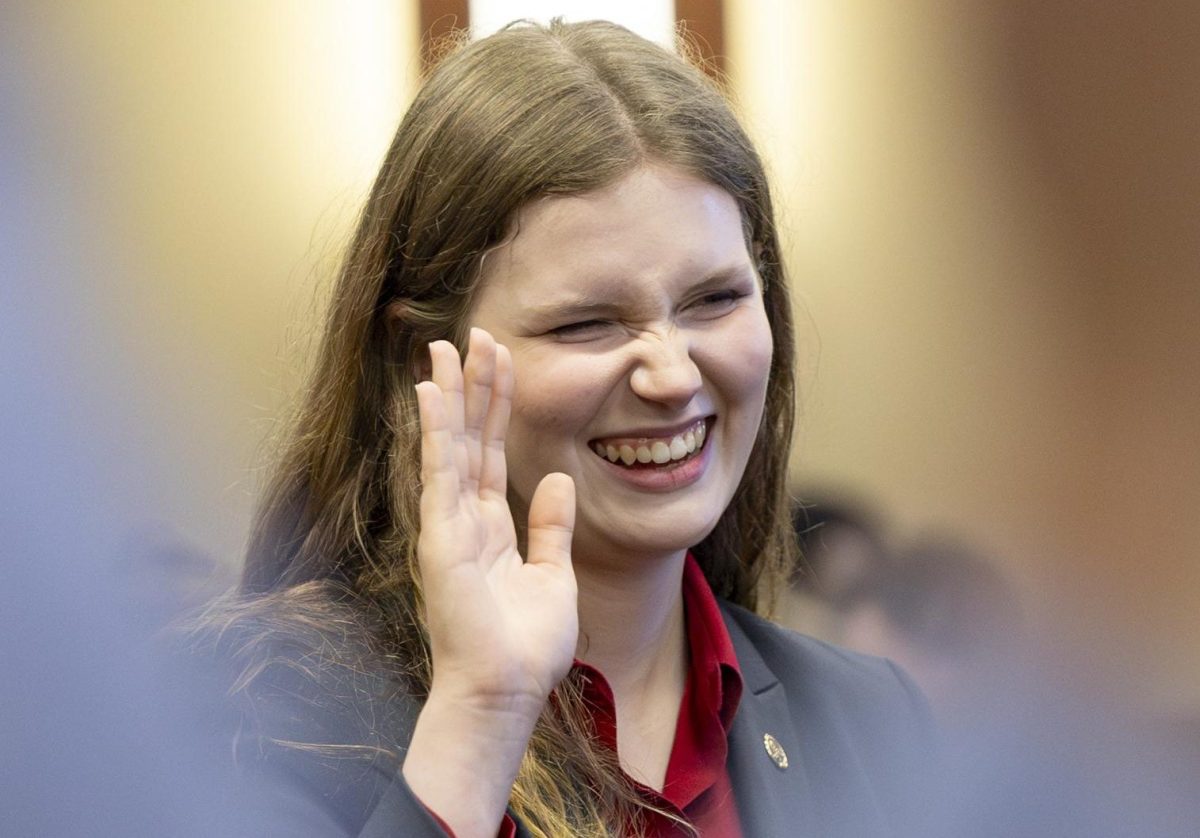
Robinson, SGA Student Body President-Elect Caden Lucas and SGA Student Body Vice President-Elect Jakob Barker attended the senate meeting to announce Lucas’s election win after the advisory member reports.
“You guys have been very appreciative of me and my administration, but I have absolutely no doubt in my mind that you guys will have better things to say about Caden and his administration,” Robinson said.
Faculty Senate Vice Chair Brooke Gross, a professor and health sciences librarian, moved the senate straight to new business following the advisory member reports.
The first order of new business on the docket sparked contention in the senate chambers.
A senate charter revision, recommended by the Colonnade General Education Committee, proposed to remove the Colonnade committee from the senate’s list of standing committees. Instead, the committee’s functions will “be re-assigned to a group of faculty appointed by the Provost’s Office” instead of elected by Faculty Senate, according to the proposal.
The committee will be renamed to the WKU General Education Oversight, Assessment, and Improvement Group.
The proposal aims to establish long-term group members. Members of the current committee serve one to two-year terms, “which limits institutional memory,” according to the proposal.
Yvonne Petkus, an at-large senator for the Art & Design Department, shared the opinions of two individuals’ responses. The first statement spoke against the change, saying that the proposal takes power out of the faculty’s hands and instead allows the administration to control the curriculum.
Eric Kondratieff, PCAL senator, cited WKU President Timothy Caboni, who previously promised the senate that “curriculum should be owned by faculty.”
Andrew Mienaltowski, an at-large senator for the Ogden College of Science and Engineering and current chair of the Colonnade General Education Committee, said that the group would not be a standing committee, but could make recommendations to the Undergraduate Curriculum Committee, another standing committee in the Faculty Senate.
Kondratieff motioned to postpone voting until after the May senate meeting. Gross said that senators couldn’t motion for postponement on an item of business until the second reading, so the motion was struck down.
Mac McKerral, an at-large senator for the School of Media & Communication, said the senators should come back in May with a more solid stance.
Petkus said she felt that senate discussions were often “cut short.” She said hearing from her colleagues affected her thoughts, and that dialogue and discussion is necessary to ensure the senate makes well-informed decisions.
The discussion on the first reading of the proposal ended after 20 minutes.
“We encourage you all to have discussions amongst yourselves and your colleagues, and encourage your colleagues to come to the May meeting,” Gross said.
Election of the senate’s chair, vice chair and secretary followed the first order of new business. Chair Dan Clark, a mathematics professor, and Vice Chair Gross will continue to serve in their roles. The senate nominated and confirmed Jennifer Walton-Hanley, a history professor, as the next secretary since current Secretary Sheila Flener is no longer eligible to run.
The senate adjourned, but did not disperse, so that senators could meet within their academic colleges to caucus for the remaining elected seats.