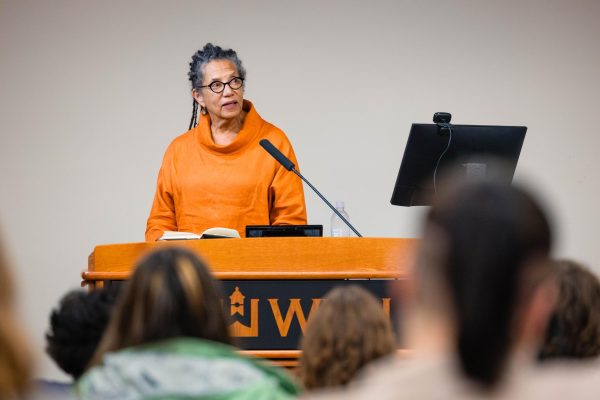
The crowd watched silently, their sights locked on her hands’ subtle gestures, her eyes’ brief flicks upward and her book’s bright yellow post-it notes.
The soft lilting tone, carefully strung phrases and memorable messaging directed their attention to the true focal point of the evening: poetry.
The WKU Gender and Women’s Studies department hosted poet Nikky Finney for a reading in the Gary Ransdell Hall Auditorium on Wednesday at 7 p.m. as part of the Catherine Ward and Gale Martin Visiting Professor Series.
Ward founded the department after coming to WKU in 1968. This is the first visiting professor she has not attended, said Marla Zubel, the department’s program coordinator.
“She’s doing well, but she’s 92, so she’s sending her regards,” Zubel said.
A book signing in the lobby followed the poetry reading. Attendees could purchase the two books Finney read from, “Head Off & Split” and “Love Child’s Hotbed of Occasional Poetry,” from a table outside the auditorium.
Finney works as a creative writing professor at the University of South Carolina. She wrote six books and hundreds of essays throughout her 30-year career, and received numerous awards. She lived in Kentucky as a UK professor for 26.5 years, Finney said.
“Kentucky is the place where I became a writer,” Finney said.
She published four books while living in Kentucky.
Finney read a selection of 10 poems. She provided the context, epigraph, and title before reading.
- The World is Round
- Coda
- The Girlfriend’s Train
- Hate
- Fishing Among the Learned
- Brother of the Back Way
- Hotbed 85
- Hotbed 49
- Penguin Mullet Bread
- Cattails
The selected poems explored Finney’s personal experiences as well as her viewpoint on outside situations.
Finney wrote “Hotbed 49” after witnessing a deer hunter biking down a four-lane highway with his fresh kill.

“When you’re a poet, you can’t look away from certain things,” Finney said. “You have to get off the highway and get your pencil and write it down fast.”
The epigraph for “The Girlfriend’s Train” originated from a conversation between Finney and a Philadelphia woman who attended her poetry reading.
“You write like a Black woman who’s never been hit before,” the epigraph stated.
The 2005 film March of the Penguins inspired the “Penguin Mullet Bread” poem. Finney recalled her mother chewing up food for her, much like penguins regurgitating food for their young, while watching the movie. The credibility of the memory was contested by Finney’s mother, who denied that it ever happened.
“There’s some other things that I feel like my spirit saw, but I didn’t physically see,” Finney said. It’s all poetic license.”
The audience grew bolder with their reactions as Finney read more, clapping, snapping and verbally responding with hums and exclamations.
“I knew this was the right place,” Finney said after an audience member exclaimed.
After the poetry reading, Zubel facilitated a Q&A.
Zubel accompanied Finney during her visit to WKU, including to a workshop with students in the English department’s intermediate poetry class.
“When we think about who to bring in, we think about who can speak across several different departments, you know, have a broader reach,” Zubel said. “Nikky Finney’s work is just so perfect in that way.”
Finney credited her father as inspiration for her work in response to an audience member’s question. Her father was a small-town lawyer in the 1960s before becoming the first Black Chief Justice of the South Carolina Supreme Court.
“My sense of justice runs through my work, I hope, like a through line straight back to him,” Finney said.
Finney shared her writing schedule, from 4 a.m. to 7 a.m. every day, for the last question asked.
“You will never have time to do the work you want to do,” Finney said. “You must make time.”
The line for the book signing after the reading ended stretched across the lobby end-to-end.
“This is a great audience. I’m glad you all came out. You’re smart, you’re kind, you’re Kentucky,” Finney said.