
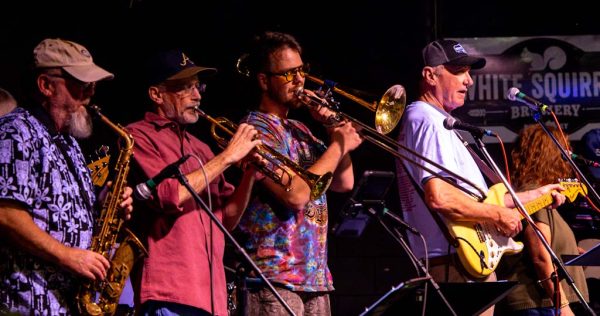
Hundreds of patrons packed White Squirrel Brewery all day Saturday for 17 live performances from local bands at the inaugural Pints for Public Media.
White Squirrel opened its doors to the event free of charge, for a day of music that spanned genres, including Bluegrass, classic rock, R&B, funk and jazz fusion. The event, organized by local musicians and community figures Alan Simpson, Ernie Small and Eddie Mills, raised more than $25,000 for WKU Public Media.
“Live music and public media do the same thing, they bring people together,” said Jordan Basham, interim executive director of WKU Public Media. “I think we’ve seen that hundreds of times over tonight.”
Kayla Mulliniks, White Squirrel’s beverage director, says the staff likes to call White Squirrel “Bowling Green’s living room.”
“We’re in a position where we can provide a space,” Mulliniks said. “It’s part of our values… We are supporters of public media.”

Small, who performed at the event with the Ernie Small Blues Band, said they wanted the event to “emphasize the importance of public media,” which has faced recent challenges following the rescission of all federal funding for public media in the United States.
“I’d say that we’ve been successful at bringing together probably the largest and most diverse kind of music in the community,” Small said.
Congress rescinded more than $1.1 billion in previously allocated funds for the Corporation for Public Broadcasting in July, which supports National Public Radio, the Public Broadcasting Service and their member stations. The CPB is expected to cease operations in January as a result of its defunding.
WKU Public Media operates WKYU, an NPR broadcasting partner and PBS member TV station, alongside a number of other broadcasts.
WKU Public Media announced in July that it would lose more than $1.2 million in the first year of cuts, a third of its budget. This loss forced it in September to cut six full-time positions and two part-time positions—a third of its staff.
“It wasn’t just going to be something that happened far away, it was going to be down the street for me,” Basham said. “It was going to be people I knew, it was going to be their jobs.”
The same month, it was announced that there would be a new contract worth $57 million over 5 years with a consortium called Public Media Infrastructure, which does not include NPR or PBS.

A settlement was reached Monday, Nov. 17, that compelled CPB to fulfill its $36 million, three-year contract with NPR for its operation of the Public Radio Satellite System. The lawsuit, which contends the legality of the contract’s April cancellation, is part of a larger, ongoing legal battle over federal funding for public media.
The settlement included a joint stipulation from NPR and CPB that Executive Order 14290, which aimed to strip all federal funding from NPR and PBS, was unconstitutional.
Basham said he believed many held a misunderstanding of what the impacts of the lost funding would be, including those in Congress.
“We’re defunded but not defeated,” said Lisa Autry, reporter-producer at WKU Public Media. “It sends a message to Congress, I think, that individual stations will still survive because we have so much local community support.”
Elizabeth Bates, who works at WKU Public Media, said that through table reservations and song requests, they had started the day with more than $13,000 in donations, a number that kept growing throughout the all-day event. Bates said local artists donated items that could be sold to benefactors, including pottery from Mitchell Rickman and posters from Matt Tullis, a graphic design professor at WKU.
“To see all of our supporters here in person, it’s incredible, it’s heartwarming,” Bates said.
Organizers emphasized the importance of WKU Public Media, which plays a crucial role in the distribution of Wireless Emergency Alerts, which include severe weather warnings and AMBER alerts, broadcast to phones, TVs and radios.

“We serve almost 4 million people across Kentucky, Tennessee, Illinois, Indiana, and tonight is going to make those communities safer,” Basham said. “It’s going to make them more enriched, more enlightened, better entertained… The impact tonight isn’t the dollar figure.”
Mulliniks said she is conscious of the impacts of natural disasters, as she and her partner were displaced by the Los Angeles wildfires at the beginning of this year.
“I think it’s really important here, especially when we have seen the devastation that tornadoes can bring to our community,” Mulliniks said.
Basham said by around 10 p.m., WKU Public Media had matched what they would typically get in a year, with 104 donors at the event.
Pints for Public Media featured more than 70 local musicians, who performed across two different stages at White Squirrel.
Jane Pearl, a musician from Bowling Green who sang with the Eddie Small Blues Band for more than a decade before she left to perform in the United Kingdom, was one of the acts at the event.
“I’ve always been a public radio person,” Pearl said. “When I couldn’t get it, and I moved to another country, that’s the only thing I had that tied me back to home.”
Erika Brady, who was a professor of folk studies at WKU from 1989-2017, emceed the smaller stage for acoustic acts in the tasting room.
“As a folklorist, that’s what we try to foster, what we try to instill in our students; an appreciation for small, face-to-face, community-based arts,” Brady said. “There is so much in our culture now that undermines this kind of connection that public radio provides.”
Brady hosted Barren River Breakdown on WKYU from 1997-2017, and said when she took over, she chose to emphasize the promotion of local artists, adding the tagline, “American music with roots.”
“A lot of the music that they program, especially Saturdays, is music you’re not going to hear anywhere else,” Mills said. “It furthers the arts by broadening our spectrum a little bit about what’s out there.”
WKU Public Media operates 4 different radio broadcasts, 4 local television broadcasts, oversees the Hilltopper Sports Satellite Network, and helps carry WKU’s student radio station Revolution 91.7.
“WKU Public Media has existed for nearly 50 years now,” Basham said. “Technology has changed throughout that time. The political landscape has changed. The financial landscape has changed. People have changed, and we’ve always found a way to move forward.”