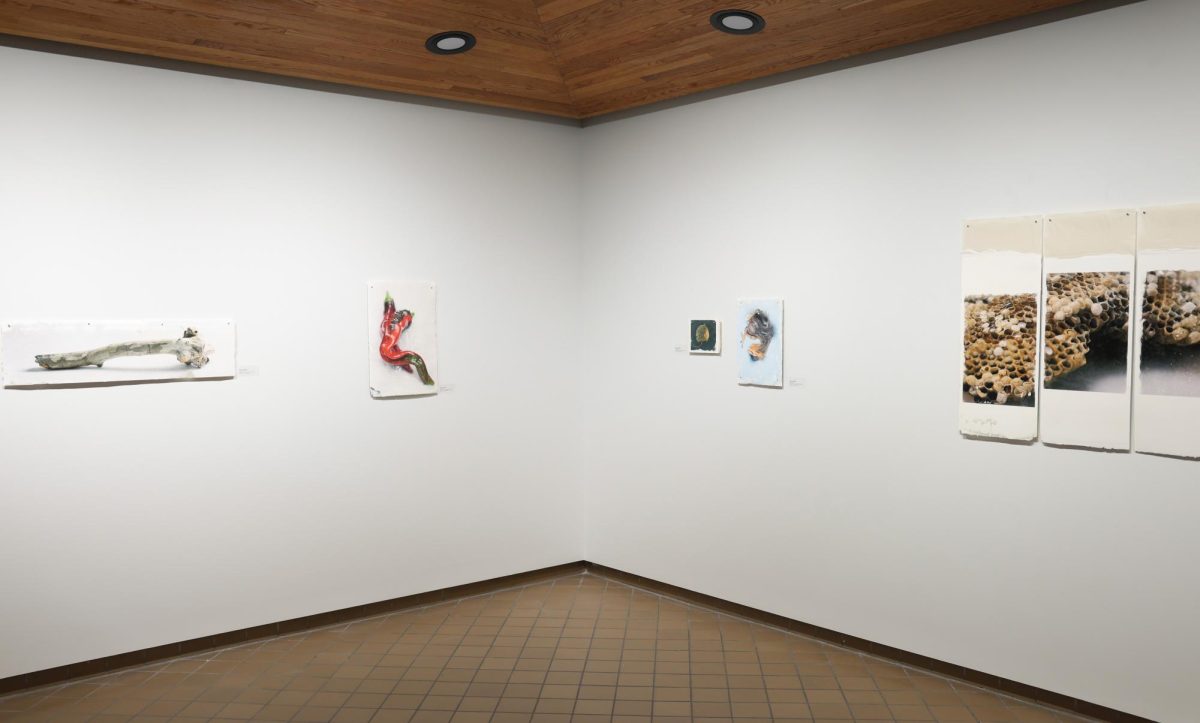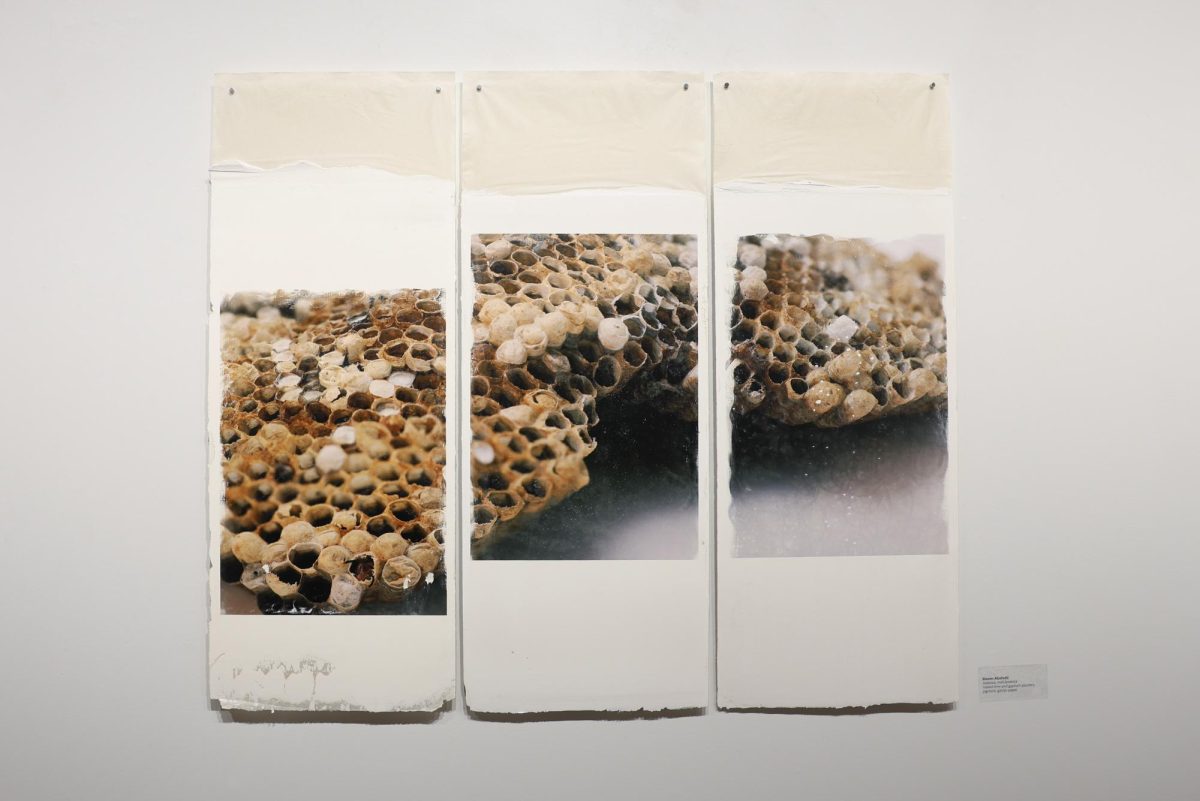
The Ivan Wilson Fine Arts Center’s first gallery exhibit of the year features Tulsa-based artist Mazen Abufadil. Abufadil’s exhibit, “Organism and Energy”, is composed of photofresco artworks exploring themes of life, death and consumption.
From a young age, Abufadil, who is originally from Beirut, Lebanon, knew he loved art.
“That’s all I wanted to do when I was in class, that was my thing,” said Abufadil. “I wanted to draw, I wanted to use paints, I wanted to use clay, and I never stopped.”
Through the years, Abufadil has worked with a variety of art forms, but has gravitated towards printmaking and photography. He said that he likes the mechanics and techniques of photography, as well as the chance for imperfection that came with printmaking.
Inspired by American graphic artist Robert Rauschenberg, Abufadil began to play around with combining printmaking and fresco, a technique where color is laid on fresh plaster to create art.
“I saw a fresco he did that incorporated some oxidation from one of (the) printmaking plates and transferred into (a) fresco,” said Abufasdil. “I realized I could probably do the same thing with my inks in my printmaking facility without having a press.”
Since the 1990’s, he has been experimenting with creating his own techniques for his photofrescos, full color prints of photos he took laid on top of plaster.
Abufadil takes apart the rollers inside of his printer, and helps guide very thin paper as it prints on the surface of the paper. Then, he takes the paper and transfers it to a slab of plaster, where he draws or paints on it until it is complete.
The photofrescos in the FAC exhibit are a culmination of three years’ worth of work, all united by the concept of life, death, and the in between. He began to think about the concept after finding a bird he couldn’t tell was alive or not, and was reinforced by the passing of his father.
The exhibit also touches on themes of consumption, through prints featuring banana peels, chicken bones, and a pebble given to him by his son. Abufadil said he started to think about human beings as consumers who are also consumed by many things.
“So we are (in) this kind of revolution of being the consumer and the consumed,” Abufadil said. “All objects around us are kind of an integral part of this ring of consumption, and we discount some of the most simple objects, like a small, little pebble, but it’s amazingly valuable.”
Abudadil’s work is extremely fragile, with frescos being easy to break if not treated with care. However, it’s also what he likes about them.
“I like the fact that the artwork is not going to be so sturdy, but the technique I’m using and the pigments I’m using, and the materials are extremely archival,” Abufadil said. “If nobody messes with it, it’ll last for hundreds of years without changing color. I kind of like that it can always be on the edge of destruction.”
Outside of being an artist, Abufadil has also taught wet darkroom and mixed media at the Holland Hall School in Tulsa for the past 26 years. He said that though he started teaching with little experience, he fell in love with it and didn’t look back.
“Over these almost three decades, I’ve learned so much about humanity through young people,” Abufadil said.