Participants of the documentary “Jonesville: Where Flowers Fall” expressed a desire for fairness and acknowledgement from WKU regarding their role in the displacement of the Jonesville residents Tuesday.
Members of the Bowling Green Community gathered in Jody Richards Auditorium for a screening of the documentary, followed by a Q&A session.
The event included food and refreshments as well as a display from the Jonesville exhibit in the Kentucky Museum.
Participants of the documentary were present as panelists for the question-and-answer portion of the event. They included Jonesville resident Alice Gatewood Waddell, Jonesville descendants Akisha Townsend Eaton and David Greer, and the film’s director, Josh Niedwick.
The event was hosted by Brent Björkman, director of the Kentucky Museum and Kentucky Folklife Program. Björkman is also one of the producers of the film. He introduced the film and panelists, as well as reflected on his own experiences of the documentary process.
“Everything comes from some place,” Björkman said, “and it was this community energy that really drove this.”
The documentary was produced by WKU Public Broadcasting Service following the display of the Jonesville mural and exhibit in the Kentucky Museum, which opened in 2022. The museum, WKU PBS, and the Jonesville Reconciliation Workgroup collaborated on the production of the documentary.
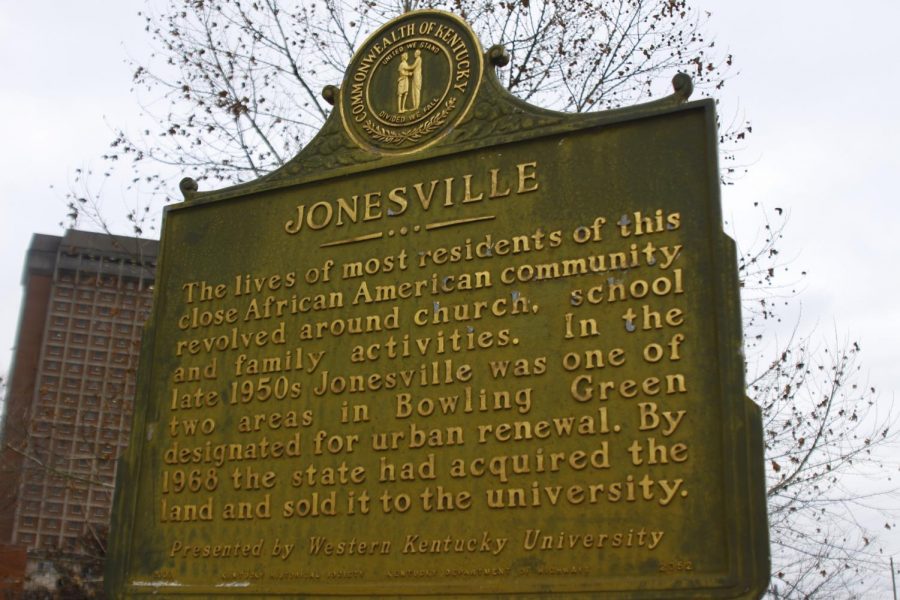
The focus of the film is on the residents of Jonesville, a long-established Black community off of Russellville Road, which was purchased by WKU in the 1960’s and completely displaced the residents.
The community resided where E.A. Diddle Arena and Houchens Stadium currently stand. The producers and participants of the documentary also place an emphasis on the lack of compensation Jonesville homeowners received when the university expanded into their community.
“It was not a run-down community, it was not blighted, it was not a raggedy community,” Jonesville resident Cornelia Jones said. “It was cheerful.”
The community included several businesses and a thriving economy, as well as an early establishment of generational wealth and homeownership.
“It would have been a great impact for our family to have developed along with Bowling Green in that same community because we were developers too, we were builders too,” Jonesville descendant Leonard Bailey said in the documentary.
The expansion of the university was spearheaded by former WKU President Kelly Thompson and was aided by the Federal Housing Administration’s guideline that allowed minority community property to be sold for less than it was worth.
During the question and answer portion of the event, Eaton addressed the signage and honors given to many of the people who played a major role in the displacement of Jonesville, including Thompson.
“Regardless of whether it’s right or wrong to have someone’s name on a building, whoever’s name is on that building today or tomorrow will have to live with the legacy that they have, good or bad,” Eaton said.
Eaton and other panelists explained the importance of transparency and fairness when it came to emphasizing certain aspects of the university to highlight and memorialize.
Audience members also asked questions regarding the desire for reparations for the outcome of the Jonesville community. Greer said shedding light on the stakeholders who continue to benefit from the university when the residents and descendants do not reap benefits from the campus’ growth.
“If you look at the growth of the infrastructure of WKU, the buildings, the housing, the sports complex, there’s many people who benefit from that growth,” Greer said, “I’ll let you fill in the ideas.”
Niedwick said he came to be a part of this process because “stories like this want to be told.”
“It was very informational,” freshman agricultural education major Alyssa Perkins said. “It was very put together and I think it represented the community very well.”
Ellie Rogers, freshman psychological science major, said the documentary was “very impactful” and important to understanding WKU’s history.
Another screening of “Jonesville: Where Sunflowers Fall” will be showing at the Capitol Theater Sunday, April 3, at 2 p.m.