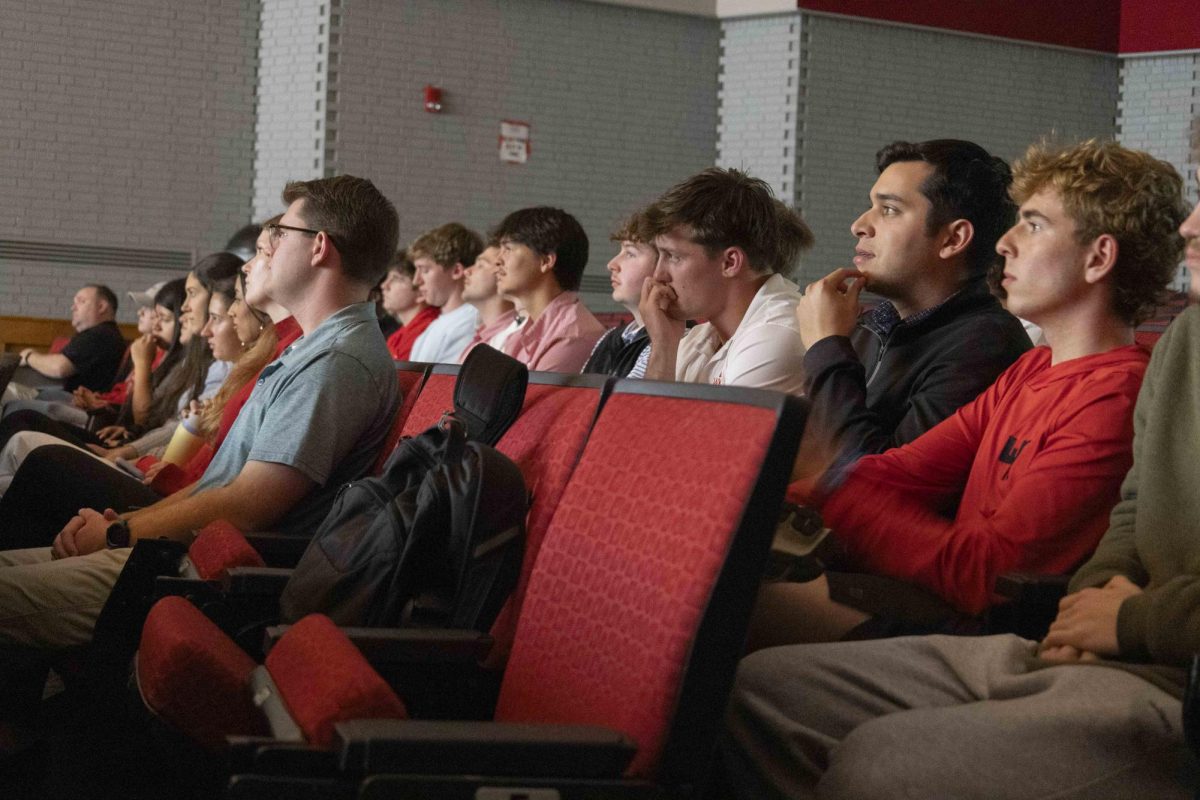
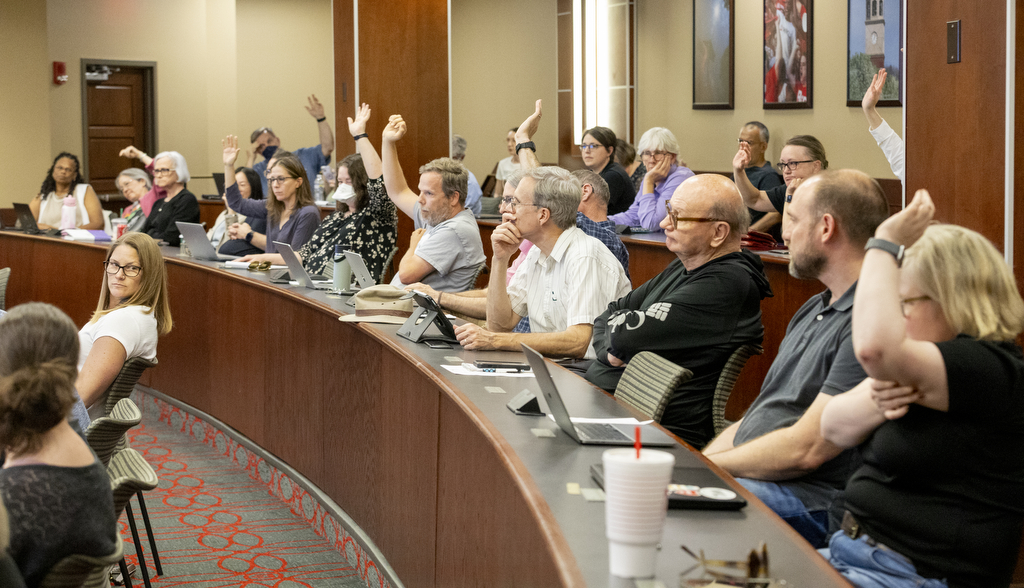
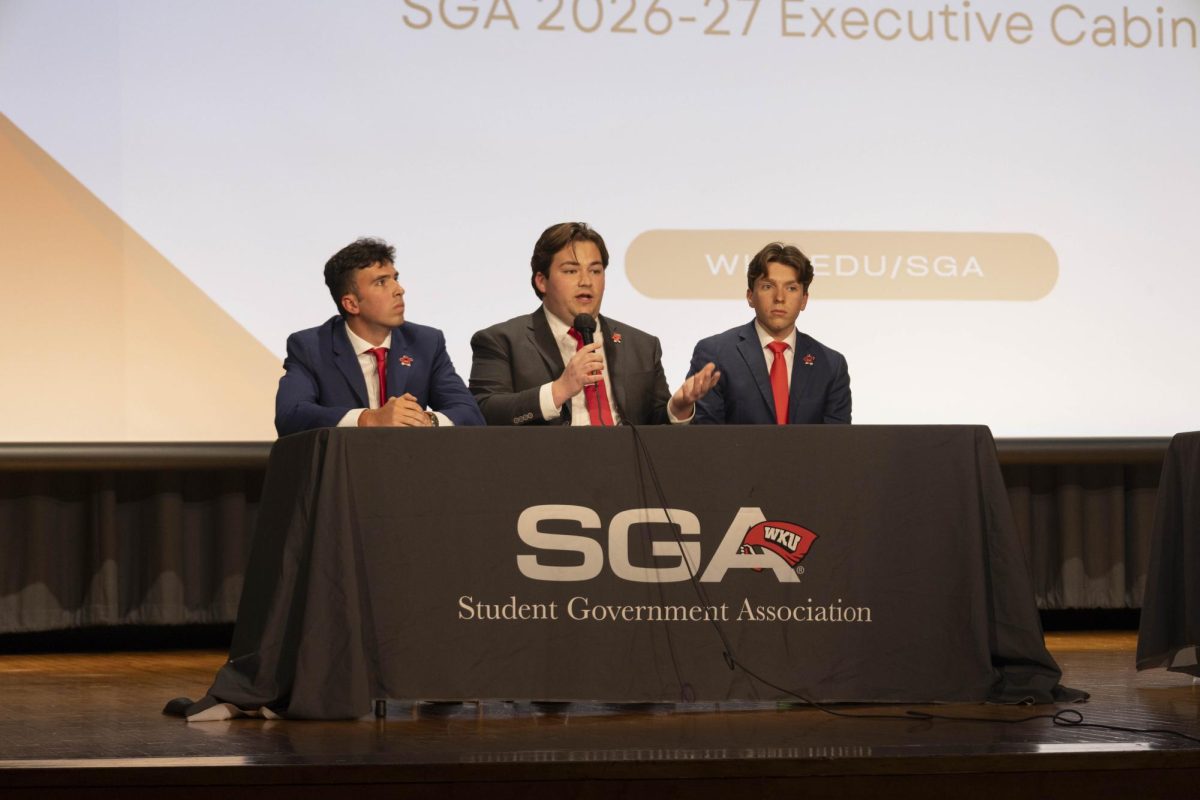
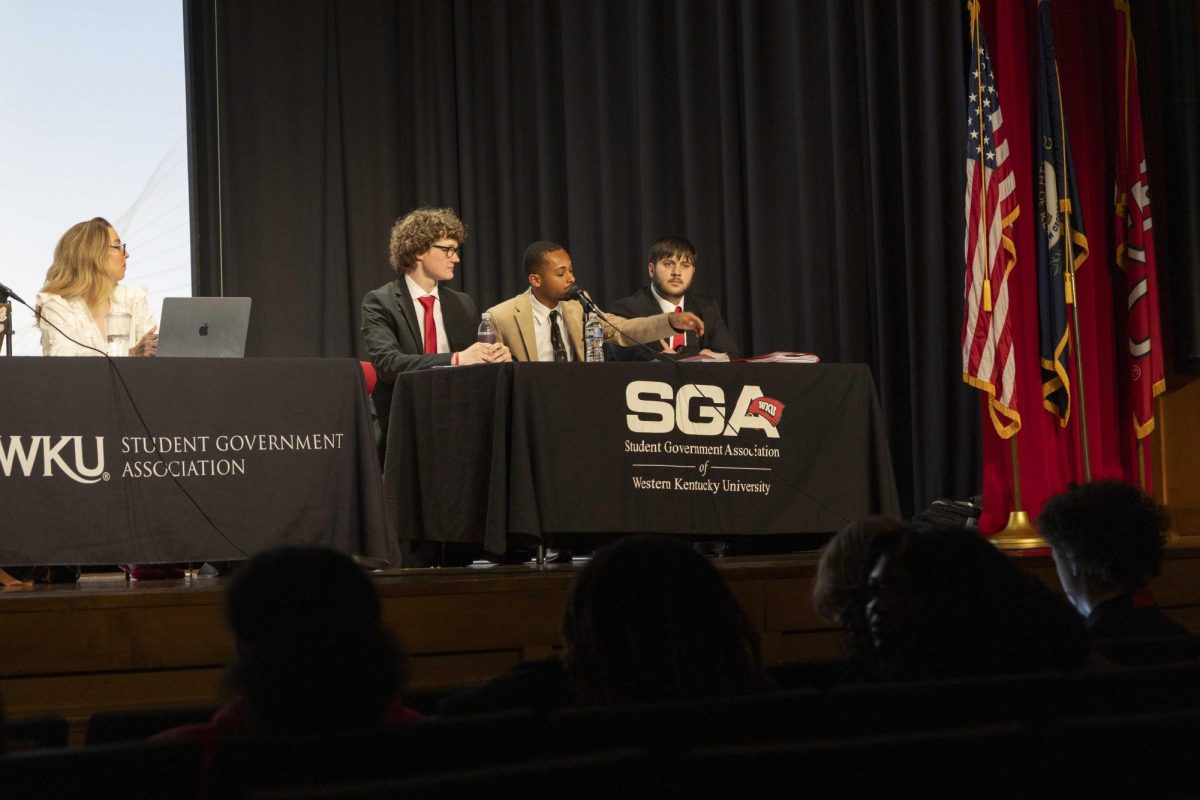
Two tickets sat on stage, three suited men on stage left, and three suited men on stage right: all students promoting their Student Government Association candidacy by answering questions about goals, issues, proposed changes and current university events.
SGA invited students to a town hall in DSU Auditorium Tuesday to meet SGA presidential candidate Caden Lucas and his ticket of Jakob Barker and Will Derryberry, and presidential candidate Jaden Marshall and his running mates Kaden Blankenship and Miles VanRude. The session showcased the two candidates running for each executive position: student body president, student body vice president and chief financial officer.
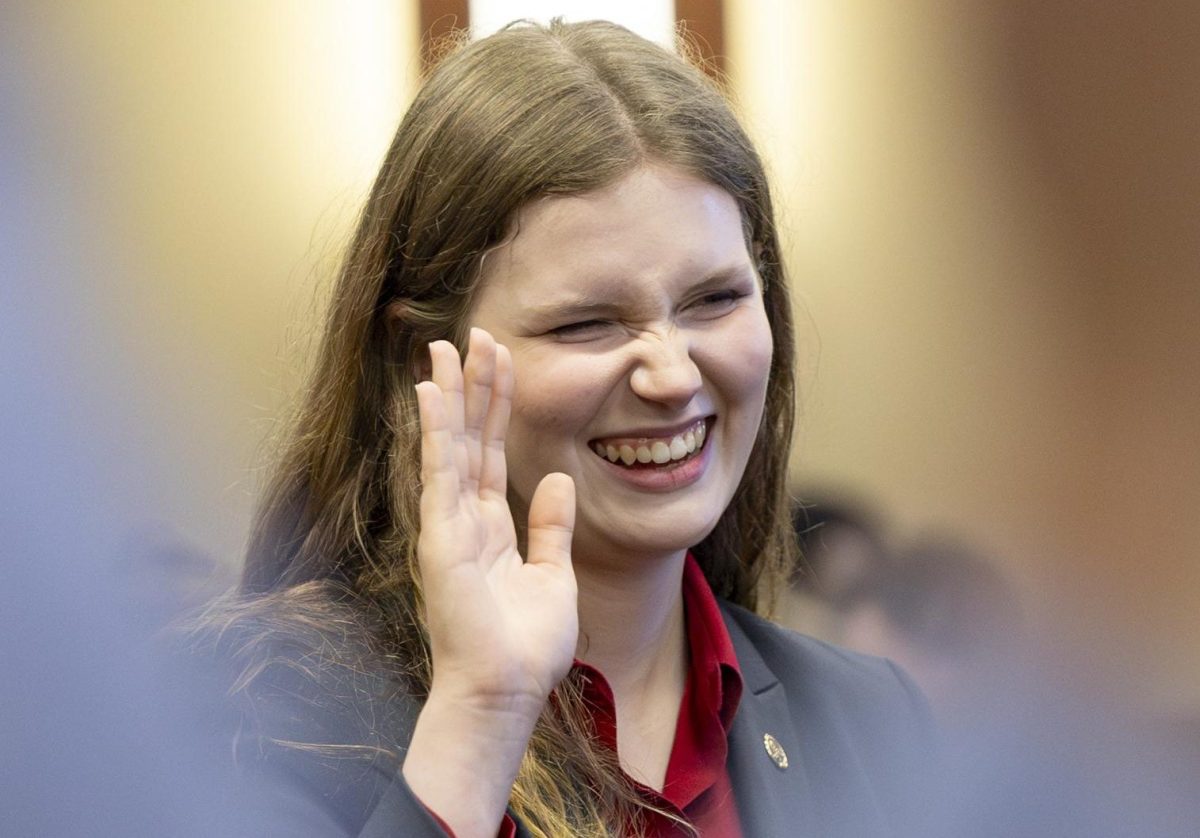
Sophie Stirling, SGA judicial council’s chief justice, moderated the event and asked submitted questions from the student body. Stirling divided the questioning period into sections: questions for all three candidates on the ticket, questions specific to each position, audience questions and one final judicial council question, followed by the ticket’s closing statement. In total, the candidates answered 27 questions.
Both tickets used their opening statements to introduce a similar main campaign goal of increasing awareness of SGA operations and promoting outreach to the student body.
“A lot of students don’t really know what SGA does, how it works or how it actually impacts it,” Lucas said. “That’s not because students don’t care. It’s simply because it’s not always clear.”
“We want to put SGA in rooms that it’s never been in before,” Marshall followed. “We want to pack the Senate chambers, if not every week, as many weeks as we can.”
Student Body President
Marshall and Lucas are the student body presidential candidates on the ballot. Marshall is the Intercultural Student Engagement Center senator, and Lucas is a junior senator.
Marshall also serves as NPHC scholarship chair, the vice president of the Why Not Us Black Male Initiative, chair of the Political Science Advisory Council and the outreach coordinator for the Campus Activities Board. Marshall’s ticket slogan is “for the Hill, for the students, for you.”
Lucas is a WKU Spiritmaster, the chairman of the Hilltoppers Vote Coalition and works for the City of Bowling Green’s Downtown Development Division. He is also a rural Kentuckian and multigenerational Hilltopper whose mother, grandfather and great-grandfather attended WKU. Lucas’s ticket motto is “lead, build, deliver.”
Stirling posed five questions for the presidential candidates about collaboration with the Board of Regents, representation of demographics, conflict between student interest and administrative priorities, goals and representing student needs.
For the first question, Marshall said he contacted Board of Regents members Cynthia Nichols, Jennifer Hammonds and Shane Spiller to learn more about the Student Regent role. He said he would focus on listening and understanding student needs before speaking up.
Lucas also mentioned working with Hammonds and Spiller, but focused on the importance of the student regent role. He discussed how the board is “future-focused.”
“My job is not only to be that number one voice for you now, but to be the voice for Hilltoppers that will be here in five, 10 years,” Lucas said.
Stirling’s final question covered how the candidates planned to balance representing all students and specific student needs.
Marshall said he’d rely on the legislative branch.
“We have senators from all different backgrounds here, and it’s amazing,” Marshall said. “So, when we produce the right legislation, we can write it for all different aspects of campus.”
Lucas detailed his process for addressing student concerns. He said he’d focus on specific needs and catalog what areas need representation.
Student Body Vice President
Barker and Blankenship are the candidates for student body vice president. Barker is a sophomore senator, and Blankenship is a first-time SGA applicant.
Stirling asked the student body vice president candidates only three questions. Her second question asked the candidates’ plans for “making scholarship opportunities more accessible and transparent for students.”
Blankenship said he plans to promote scholarships on social media and make applying easier by setting less strict GPA guidelines.
Barker has previous experience working with SGA scholarships as the SGA Student Experience Committee chair. Barker reworked the grading process and expanded the Bluegrass Leadership scholarship to Tennessee applicants. He said he plans to transition applications from paper to digital.
Stirling’s final question for the vice presidential candidates asked how they’d incorporate housing initiatives during the university’s transition from the Student Life Foundation to a public-private partnership.
Barker acknowledged that housing has been a “friction point for students across the Hill.” He said the student body vice president’s role previously was to advocate for students to the SLF.
“As we’re moving into that private partnership, that P3 (public-private partnership) plan, we need to understand that regardless of whether it’s a public plan or a private partnership, it needs to still have student representation,” Barker said.
“One of my main focuses is making sure that administration is focusing on improving dorms,” Blankenship said, based on his experience living in Douglas Keen Hall, which he described as “old” and “dilapidated.”
He also plans to address long response times to maintenance request forms.
Chief Financial Officer
VanRude and Derryberry are competing for the title of chief financial officer. VanRude is a senator-at-large, and Derryberry is a sophomore senator.
The candidates revealed their differences in policy early in the town hall during a question about the stipends SGA’s executive branch receives.
“Almost 25% of the total SGA budget is allocated to stipends per year, according to the published budget on the SGA website,” Stirling said. “While it’s understood that these positions are difficult, do you think this number is large and that the positions on a ticket, President, VP and CFO, should be completely volunteer to allow for more allocation of funds in other areas of the budget?”
While Lucas, Derryberry, Marshall and VanRude agreed that serving in an executive position means more than a paycheck, VanRude and Derryberry cited different estimates of the hourly wage an SGA executive earns.
Derryberry said that the stipend, divided by mandatory hours spent in the office, calculates to $9 per hour, “which is the exact same amount as every other student worker on this campus,” he said.
In response to a later question, VanRude provided a different statistic.
“These positions get paid more like $13, $16 and $20 an hour,” VanRude said. “I covered it with the current CFO yesterday, and there’s definitely room to lower that, allocate more to the budget, to fund initiatives and help the campus as a whole.”
The Herald asked SGA Student Body President Rush Robinson for clarification.
“These hourly rate estimations vary greatly based on what assumptions are made,” Robinson told the Herald. “If you use the bare minimum office hours required by the constitution, hourly rates range from $20.31 to $6.25. If you factor in additional meetings, it changes to $16.25 to $3.91. If you assume people are doing more than the bare minimum constitutional requirement (which they are)… then that number drops even lower.”
Both candidates complimented the current executive branch and current Chief Financial Officer Gabriel Jerdon’s work, ensuring the school’s finances are precise and put to good use, accommodating student needs.
VanRude said he’d do the same by carefully reviewing bills for accuracy and precision. Derryberry said he’d ensure the integrity of SGA’s spending by upholding anonymous voting practices, which the association recently adopted.
The final question, posed by the judicial counsel, asked the tickets “Why are you the better ticket?”
Marshall said that his ticket has “passion,” a word he described himself and his running mates with multiple times during the town hall. Blankenship added that he made sacrifices to run for SGA. VanRude said that their ticket challenged each other, which would lead to “creative abrasion” and more comprehensive solutions.
Lucas’s ticket focused on their collective experience in SGA. Lucas joined under Savanna Kurtz, student body vice president, and jumped into legislative operations. Barker was elected as a freshman and said he “learned how the system works” and “how to advocate for students in the best way possible.” Lucas said that each member of his ticket views SGA as a family.
Voting opens Monday at 7 p.m. on TopNet, and closes at 7 p.m. on Wednesday. Results will be released in the SGA Chambers and on social media immediately after the election closes.