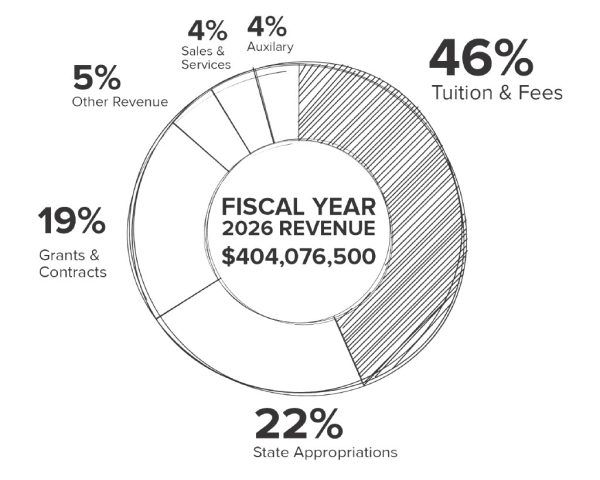
Undergraduate tuition and fees are the largest single revenue source for WKU’s current academic year, accounting for 46% of the university’s revenue, according to the budget.
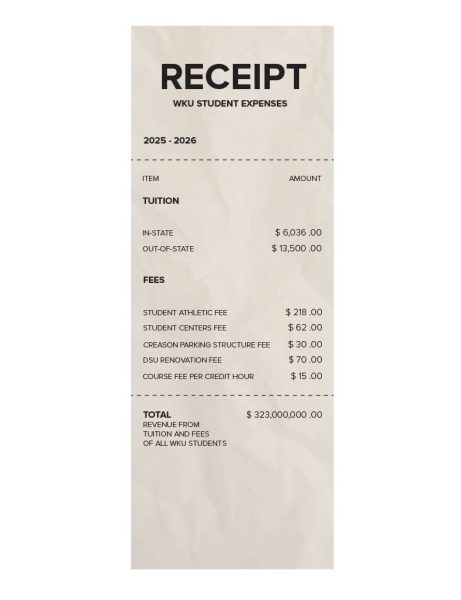
Every WKU undergraduate student pays the same baseline tuition per semester, which accounts for $323 million of the $798 million total revenue. For the 2025-26 academic year, tuition is $6,036 for an undergraduate resident or border state student per semester, and $13,500 for an undergraduate, non-border state student.
This year, WKU undergraduate students paid $298 million in tuition, a 1% increase from the previous fiscal year.
Assistant Vice President for Budget, Finance and Analytics Ronaldo Domoney said tuition money pays for faculty salaries, utility bills, campus maintenance, international technology and other business operations that allow WKU to stay in operation.
Outside of tuition, all students must pay mandatory fees per semester, which for the 2025-26 academic school year include:
• $218 Student Athletic Fee
• $62 Student Centers Fees
• $30 Creason Parking Structure Fee
• $70 Downing Student Union Renovation Fee
The Student Athletic Fee goes towards athletic operations within the university and student experience, like admission to university sporting events.
“Nearly all universities with athletic programs charge a similar student athletic fee,” said Brian Dinning, executive director of Budget and Financial Planning for WKU.
Some universities with a similar athletic fee include the University of Louisville, $200 per semester, Kennesaw State University, $211 per semester, and Middle Tennessee State University, $313 per semester.
The Student Centers Fee pays for operations in DSU, including staffing, utilities, maintenance and student events hosted in the space.
The Creason Parking Structure Fee goes towards the “debt service” which is the money paid within a certain amount of time to fully repay debt from the construction of Parking Structure 3, which was completed in 2018.
Voted on by the Student Government Association in 2012, the DSU Renovation Fee covers the cost of the DSU renovation that was completed in 2014. The renovation included adding more meeting spaces for students, redoing the WKU Store, replacing Izzi’s and Topper Grille with Steak ‘n Shake and adding a Starbucks.
Domoney said part of the debt that WKU has taken on was to pay for the DSU renovation.
For the 2025-26 academic year, the budget accounts for $24.7 million in student fees, a 33% increase from the previous academic year.
Dinning said fee revenue has increased due to the new college fee structure.
While the college fee model costs more, Dinning said it creates “a more predictable and transparent cost structure for families.”
Four days before the start of their senior year, graphic design major Danny Brooks’ parents told them they would no longer contribute half of Brooks’ tuition fees.
Already in debt due to loans, Brooks still struggled to afford tuition despite being eligible for aid through WKU.
Brooks, who has been attending WKU for the past three years, said they knew tuition went toward campus upkeep and professor salaries, but was unaware of its full extent..
Brooks resents that administrators charge students thousands of dollars per semester, while Brooks is “sitting here picking and choosing whether or not I can afford to get food at the end of this week.”
The Herald sent out a survey to WKU students, attempting to gauge general knowledge about tuition and fees. Out of the 16 people who responded, 14 students said they didn’t know where their tuition was going.
Throughout the survey, students said they had a lack of knowledge about WKU’s tuition and fees, course fees and how that applies to this year’s budget.
Out of the 16 responses, 15 students said they were unaware they were paying the Athletic Fee, Parking Structure Fee and Renovation Fee, and 14 said they were unaware that they paid the Student Centers Fee.
“I come to this school and pay a fortune for MY education, and I do not like to think about the fact that my hard-earned money is going towards an ‘athletic fee’,” said Jillian Skidmore, a freshman communication science and disorder major, in the survey. “I have nothing to do with that and we are charged outrageous amounts for facilities and updates we don’t use or need.”
Course fee changes and college revenue
In previous years, course fees were determined by specific classes and covered equipment, room or gear. This year, the course fees have been changed to be distributed universally.
Student tuition and fees are divided among WKU colleges based on course load and college enrollment.
For instance, if a Potter College of Arts and Letters student is only taking general education classes at Ogden College of Science and Engineering, 25% of the student’s tuition would go to PCAL, and the other 75% would be allocated to Ogden, said Susan Howarth, the vice president for strategy, operations and finance.
Classes get the money through a small fee that students pay per credit hour they are enrolled in, rather than paying different fees per course.
This fee varies depending on which college a student is enrolled in. The College of Education and Behavioral Sciences, Ogden and PCAL have a $15 per-credit hour fee, while the College of Health and Human Services and the Gordon Ford College of Business have a $20 per-credit hour fee.
Course fees varied before the new system. Most students were unaware of which classes had course fees, making it difficult for students to plan ahead. The new course fee system is “more predictable for students,” Domoney said.
Some students, such as Brooks, said they dislike the new way of distributing course fees.
“Beforehand, I knew that my course fee for that class was going to pay for certain equipment,” Brooks said.
Now, Brooks said the “money is mixed together,” which makes it more difficult to know how each dollar supports class needs.
How is your money spent?
The university was spending roughly $25 million more than it was bringing in annually when Howarth took her position in 2019. Solutions were implemented after the COVID-19 pandemic.
One of the biggest steps WKU took to lessen costs was reducing each college’s budget by a certain amount. The budget department allowed deans to decide the reductions for each college.
“We didn’t say: oh, you have to reduce your workforce by X amount of people, or you can’t travel,” Domoney said.
The university cut costs by incentivizing early retirement and shrinking its workforce without firing employees, Domoney said.
A balanced budget benefits the university by allowing it to keep the amount of money available in its bank accounts, which allows WKU’s credit rating agencies to view the university as fianacially healthy.
“It ensures that we’re financially sustainable for the foreseeable future,” Howarth said.
Students are sometimes unsure of how the university spends their money.
“I just always assumed (my tuition) was being wasted on stuff like concerts and Cherry Hall’s renovations,” said freshman broadcasting major Alyssa Schuler said in a response to the survey.
Brooks said paying tuition is just a fact of life, but would appreciate it if the university were more proactive about informing students of what fees they are paying.
The money gets back to the students, as student retention and success services often get funded when “excess” money is created, Domoney said.
Avoiding cuts also allows the university to offer more sections of required courses, Dinning said.
“If you had a course that’s required, and now it can only be taught in the fall, if you need that, you may need to stay an extra semester to graduate,” Dinning said.
The university is currently working to expand initiatives, like living learning communities, that have seen increases in student success.
When comparing students’ participation in an LLC, Domoney said LLC-based students had heightened success and retention.
Howarth said recent conversations have been had concerning the expansion of LLCs and other student success initiatives. She said it’s a matter of “dollars and space,” but that the university wants to increase spending in areas where students participate and succeed.