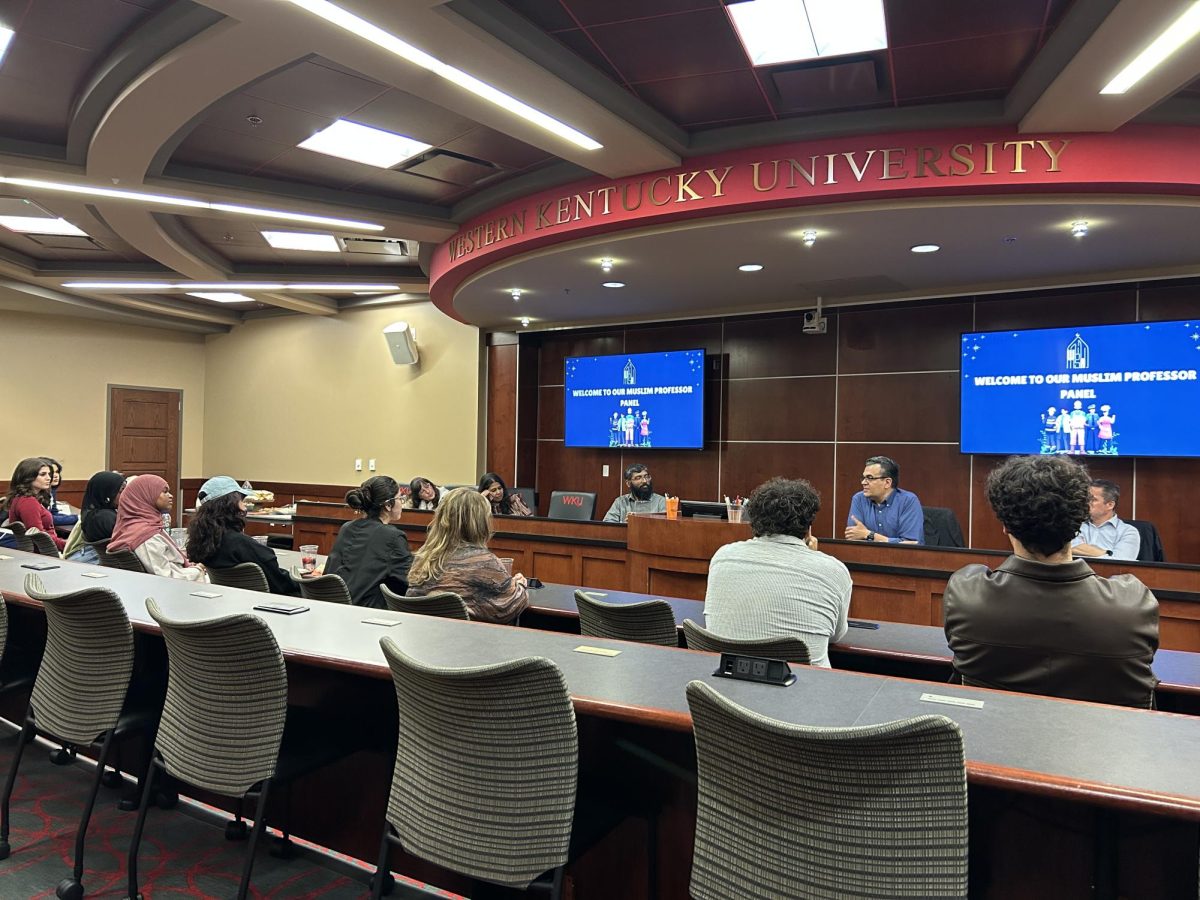
As the rest of DSU quieted for the night, the SGA chamber was lively with conversation over a table of refreshments as WKU’s Muslim Student Association, WKU professors, and a local religious leader settled in for a night of thoughtful discussion.
On Friday, Nov. 14, Muslim professors from various WKU departments joined MSA to discuss the interaction between their faith and career paths, and answer questions from attendees.
Imam Sedin Agic from the Islamic Center of Bowling Green, assistant professor of mechatronics engineering technology A.K.M. Foysal Ahmed, assistant director of The School of Engineering and Applied Sciences and professor of architectural sciences Shahnaz Aly, associate professor of architecture science O.E Mansour, associate professor of Computer Information Systems Yasar Mowafi, all within the WKU School of Engineering and Applied Sciences, and Sophie Arjana, associate history professor whose areas of interest include anti-Muslim rhetoric and Islamophobia, were on the panel.
MSA President Annie Khazi said the original idea for this event stemmed from her own experience navigating career paths and varying academic pressures in college. She said this event is something she wished she had herself experienced as a freshman as she may have discovered her passions much earlier.
“I wanted to host a panel featuring different Muslim professors from different backgrounds who didn’t go the traditional route,” Khazi said. “I feel like especially as immigrants, we’re definitely pushed into certain careers more than others.”
Each professor began with introductions and stories of how they ended up living or teaching in Bowling Green. For most, it was a journey of leaving their birth country for new opportunities. Associate Professor of Architectural Science, O. E. Mansour, was born in and lived in Cairo for several years before moving to Canada and then the United States. He said he felt a calling to the profession from a young age.
“This was very early in my life and I decided deeply in my heart to become an architect,” Mansour said.
After earning his license as a professional architectural engineer, he spent several years designing buildings in the United Arab Emirates, Saudi Arabia and Egypt. After the 2011 Egyptian Revolution, he moved his family to Canada where he completed his Master’s and Doctoral degrees in architectural engineering.
“I have two things in my life supported by my faith: focus and persistence,” Mansour said. “If you want to be an architect or engineer, persist.”
He said that Islam teaches that the only way to be patient is practicing patience and the only way to be well-educated is to practice learning.
As the panel transitioned to Q&A, attendee Aséela Abendeh asked for career advice. Abendeh worked as a software engineer in Jordan, but since arriving in Bowling Green, she has yet to find a job in her area of expertise.
“I have the time. I have the effort. I have the energy. I don’t have the opportunity, Abendeh said. “And I feel like I’m being wasted.”
Shahnaz Aly said she related to Abendeh’s experience. After moving to Canada from Mumbai, India to work as an architect, Aly said that employers were always specifically searching for “Canadian work experience,” overlooking her years of work in India and thus making job-seeking markedly more difficult. However, she told Abendeh not to give up, complimenting her drive and passion.
Foysal Ahmed, assistant professor of mechatronics engineering technology in his first year at WKU, added to this sentiment, offering to help Abendeh find connections.
“You will get (employment), and when you get it, you will regret it because you won’t have time for anything else,” he said while laughing.
The panel concluded the event by speaking on the experience of being Muslim at a university in a predominantly non-Muslim campus. When asked about how to deal with microaggressions and discrimination at school, Aly said that she feels obligated to share the same advice to students as she does to her son: don’t let anyone stand in the way of your education. She emphasized focusing on your own achievement and never stooping down to someone’s hateful level.
“Yes, you should stand up for your rights, don’t get me wrong, but we live in a time that isn’t very favorable for us in a way,” Aly said.
Arjana told students they should report any racist or Islamiphobic remarks made by a student or professor, and offered herself as a resource if a student ever feels uncomfortable or threatened.
“There is nothing wrong with you; there is nothing inferior about you,” Aly said. “Your religion gives you your confidence and you should have the confidence to be yourselves.”